Thickness gets all the attention when people spec a yoga mat, but the dimension that decides whether a mat actually works for the person on it is the footprint: how long and how wide. A mat that is a few inches too short turns every reclined pose into a negotiation with the floor, and a mat that is too narrow crops the base of every wide stance. For a custom order, especially one going to a studio, a gym, or a branded retail line, choosing length and width on purpose is what separates a mat people reach for from one that gets rolled into a corner.
The standard, and why it now means two sizes
For years the default yoga mat was 68 inches long by 24 inches wide, and that traditional standard is still everywhere. The market has quietly shifted, though, and 72 by 24 inches has become the modern standard for a full-size adult mat. The extra four inches of length costs almost nothing in materials but comfortably fits a wider range of adults, which is why many brands now treat 72 inches as their baseline and reserve 68 inches for budget or compact lines. The width has held steady at 24 inches for the standard because it maps to the shoulder-to-shoulder footprint of most practitioners in a neutral stance.
Decide which standard is your baseline before anything else, because it anchors the whole size range you offer. If the order is a general studio or retail run, 72 by 24 is the safer default in 2026. If it is a giveaway, a hotel amenity, or a kids’ program where compactness and cost matter more than a perfect fit, 68 by 24 still earns its place.
Length: size to the tallest regular user
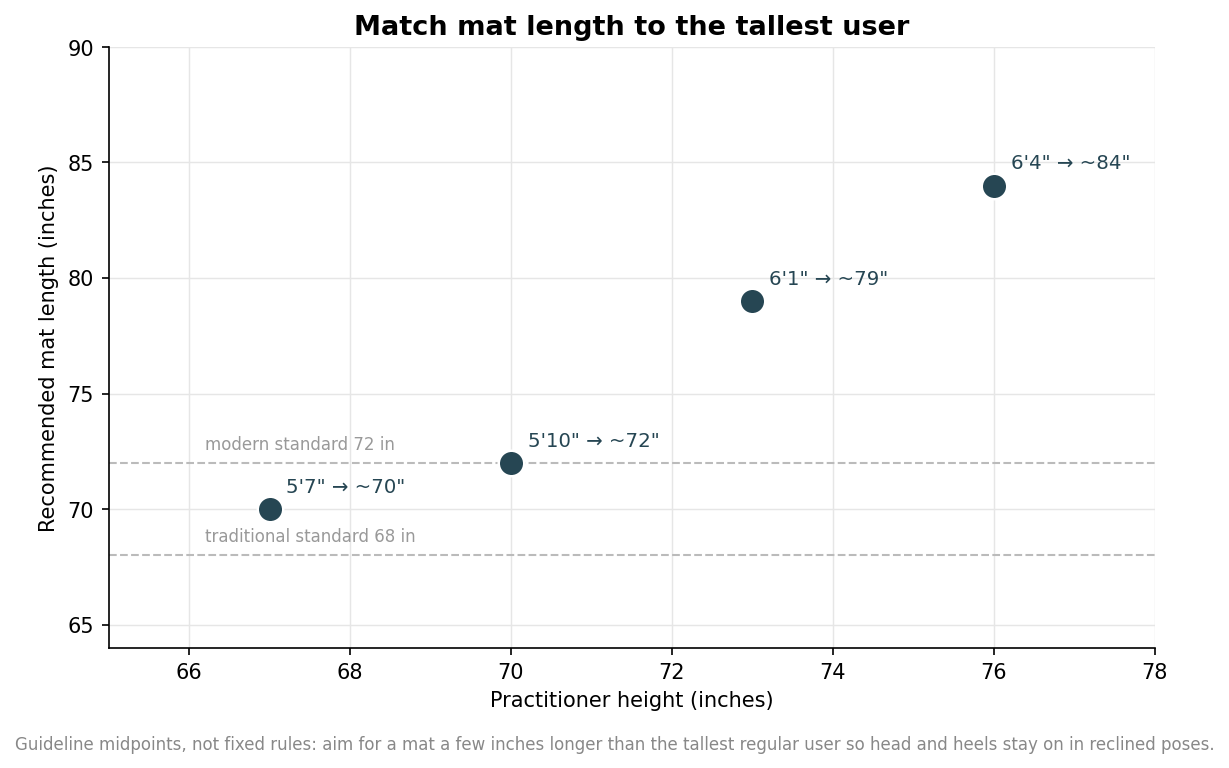
Length is the dimension people most often get wrong, and the rule is simple: the mat should run a few inches longer than the tallest person who will regularly use it, so the head and heels both stay on the surface during lying poses. As a working guideline, practitioners up to about five foot seven are well served by a 68 to 72 inch mat. From five foot eight to six foot, 72 inches is the comfortable fit. Past six foot, the mat needs to grow with the body, into the roughly 78 to 80 inch long category around six foot one to six foot three, and up to 84 or 85 inches for anyone taller.
These bands are guidelines rather than hard cutoffs, and the safe move for a shared setting is to size up. A studio that buys a single length has to buy for the tallest likely student, not the average one, because a short student on a long mat loses nothing while a tall student on a short mat is uncomfortable every session. For a branded retail line, offering a standard length plus one extended length covers the tall market that most competitors ignore.
Width: how much lateral room the practice needs
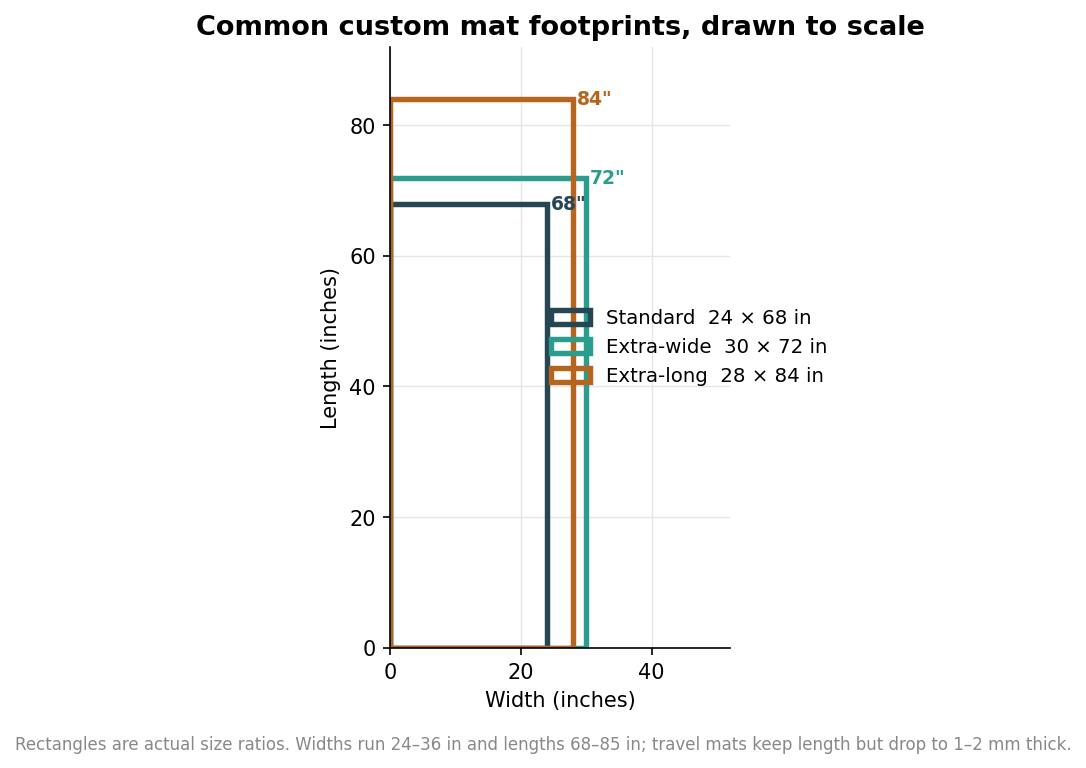
Width is where the practice style, not just the body, drives the choice. The 24 inch standard is fine for a contained vinyasa or a seated practice, but it starts to feel narrow the moment poses go wide: a low lunge with the arms out, a wide-legged forward fold, or any flow with lateral movement can put a hand or a foot off the edge. Extra-wide options step up to 26 and 28 inches, and dedicated wide mats reach 30 and even 36 inches for practitioners who want to stop thinking about the edges entirely.
The tradeoff for width is real estate and cost. A wider mat uses more material, weighs more, and takes more floor and storage space, which matters when a studio has to fit a full class into a room or a retailer has to ship efficiently. For most orders, 24 inches remains the sensible default and a 26 to 30 inch option serves larger bodies and wider practices; the 36 inch mats are a specialty item rather than a general-purpose size. The chart below shows how these footprints actually compare when drawn to scale.
Where thickness and portability meet size
Footprint does not live in isolation from thickness. Travel mats keep adult length, typically 68 to 72 inches, but drop to roughly one to two millimeters thick so they fold or roll down small and light, trading cushioning for portability. General-purpose mats sit in the three to six millimeter range, and thicker comfort-focused mats run up to eight to ten millimeters. A longer, wider mat in a thick gauge becomes noticeably heavier and bulkier, so if the order is meant to travel, hold the length at standard and take the thickness down rather than chasing an oversized footprint that will not pack. Weight scales with all three dimensions at once, and it is the spec buyers feel every time they carry the mat, so it deserves a place in the decision.
Specifying a size for a bulk or brand order
The order sheet comes down to three deliberate choices. Set the length to the tallest regular user, defaulting to 72 inches for a general run and stepping to 78 to 84 inches when the audience skews tall. Set the width to the practice, keeping 24 inches as the baseline and offering 26 to 30 inches where larger bodies or wider styles are in play. Then reconcile against thickness and portability, thinning the gauge before shrinking the footprint if the mat has to be carried. Figures throughout are indicative industry ranges, so confirm the exact dimensions and tolerances with your manufacturer before you lock the run. Nail the footprint to the actual users and the mat earns its spot on the floor instead of in the closet.
Leave a Reply