Category: Uncategorized

  • Yoga Mat Thickness, Explained: Choosing the Right mm for Studio, Retail, or Events

    Yoga Mat Thickness, Explained: Choosing the Right mm for Studio, Retail, or Events

    Thickness is the first spec people obsess over when they buy a yoga mat and the one they most often get wrong. It is measured in millimeters, it ranges from about 1.5 up past 10, and there is no single right answer, because thickness controls a trade-off rather than a quality level. Understanding that trade-off is what lets a studio, a retail brand, or an event organizer pick a mat that people actually want to stand on.

    The one trade-off that governs everything

    Every millimeter you add to a mat does two things at once: it adds cushioning under the knees, wrists, and spine, and it takes away stability underfoot. A thin mat puts you almost directly on the floor, which is exactly what you want in a standing balance or a flowing sequence, because you can feel the ground and your ankles have a firm base. A thick mat feels plush in a kneeling stretch but turns wobbly the moment you try to hold tree pose on it, because your foot sinks into foam that keeps moving. You cannot buy your way out of this with a better material; it is a physical consequence of putting more compressible foam between the body and the floor.

    That is why the honest way to choose is to decide which side of the trade-off your practice lives on, and then buy the thinnest mat that still protects the joints you care about. Most people over-buy on cushioning and then quietly struggle with balance for months.
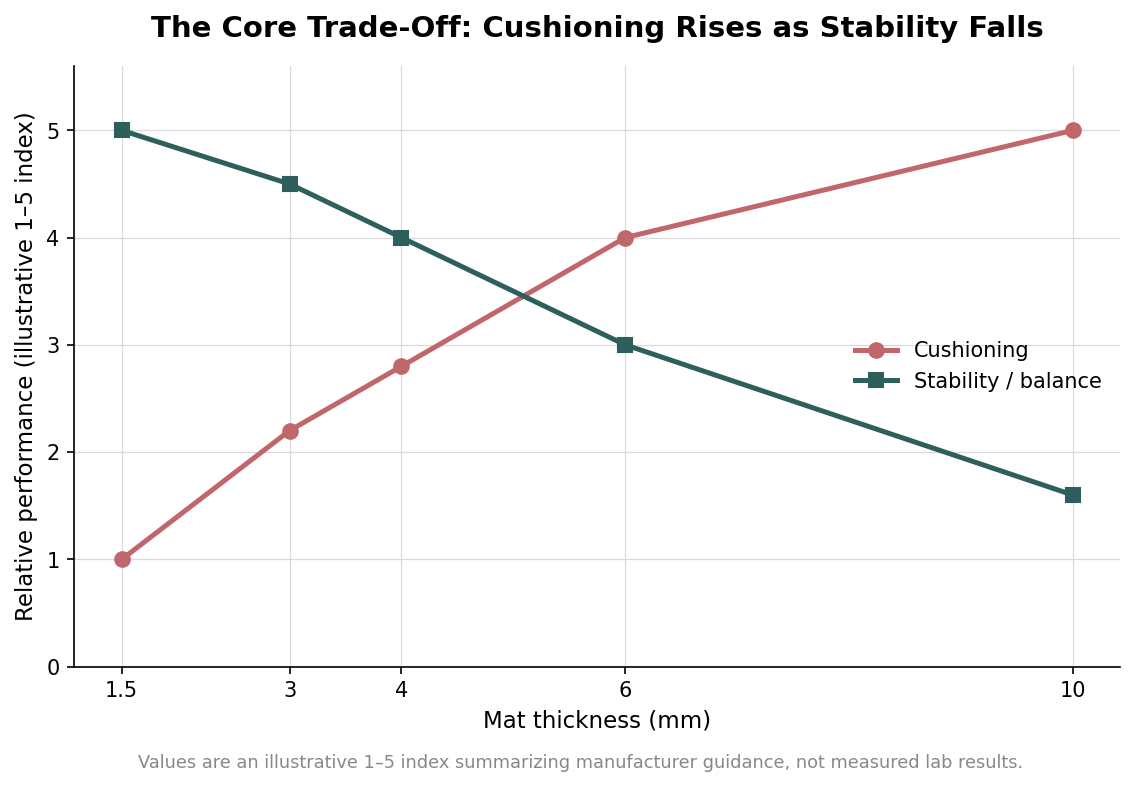
    Line chart showing yoga mat cushioning rising and stability falling as thickness increases from 1.5mm to 10mm
    Adding thickness trades stability for cushioning; the two move in opposite directions across the range.

    The thickness tiers, and who each one is for

    Around 1.5 to 2 millimeters is travel territory. These mats fold or roll small enough for a backpack and give maximum stability, but they offer little padding, so a bare wood or concrete floor will be hard on the knees. They suit commuters and anyone laying a personal layer over a studio’s own mats.

    Three to four millimeters is the workhorse standard, and it is where most serious practice happens. It balances enough cushioning for everyday postures against enough firmness for standing work and inversions, which is why it is the default for flow styles and hot yoga. If you are outfitting a studio and want one thickness that offends no one, this is it.

    Five to six millimeters is the comfort tier. It protects sensitive joints and suits restorative and gentle practice, at the cost of some balance and noticeably more weight and bulk. High-density versions resist the dreaded feeling of bottoming out, where the foam compresses fully and you feel the floor through it anyway. Eight to ten millimeters and up crosses into Pilates and general fitness use; it is genuinely too soft and bulky for standing yoga balances, and it is heavy to carry and store.

    Millimeters alone do not tell the whole story, because density changes what a given thickness feels like. A dense natural-rubber mat at 4 millimeters can feel firmer and more supportive than a soft foam mat at 6, and it will usually weigh more for the same dimensions. That is why comparing two mats purely on their stated thickness can mislead you: a low-density mat pads the specification sheet without padding your knees, and it is the mats that compress to nothing under load that generate the most complaints. When you can, judge a sample by pressing it under your full body weight rather than by the number on the label.

    Thickness is not grip, and confusing the two costs money

    A recurring mistake is assuming a thicker mat grips better. It does not. Grip comes from the surface material and its texture, not from how much foam sits underneath. A 3 millimeter mat with a well-textured or rubber top can hold a sweaty hand far better than a soft 8 millimeter mat with a slick surface. For a custom-printed mat this distinction matters even more, because the print sits on the top surface, and the choice of that top layer drives both how the artwork looks and how well the mat holds a pose. Decide grip and print surface as their own spec, separate from thickness, rather than assuming one solves the other.

    Sizing rides alongside thickness

    Length is the spec buyers forget until a tall member’s heels hang off the end. The traditional standard is about 68 by 24 inches, which fits average heights, while full-size mats run to roughly 72 by 24 inches for taller practitioners. Long and extra-long options reach 78 to 84 inches, and wide mats step out to 26 inches for more lateral room. For a studio or brand ordering in bulk, choosing a slightly longer standard than 68 inches is a cheap way to fit a wider range of bodies without stocking multiple lengths.
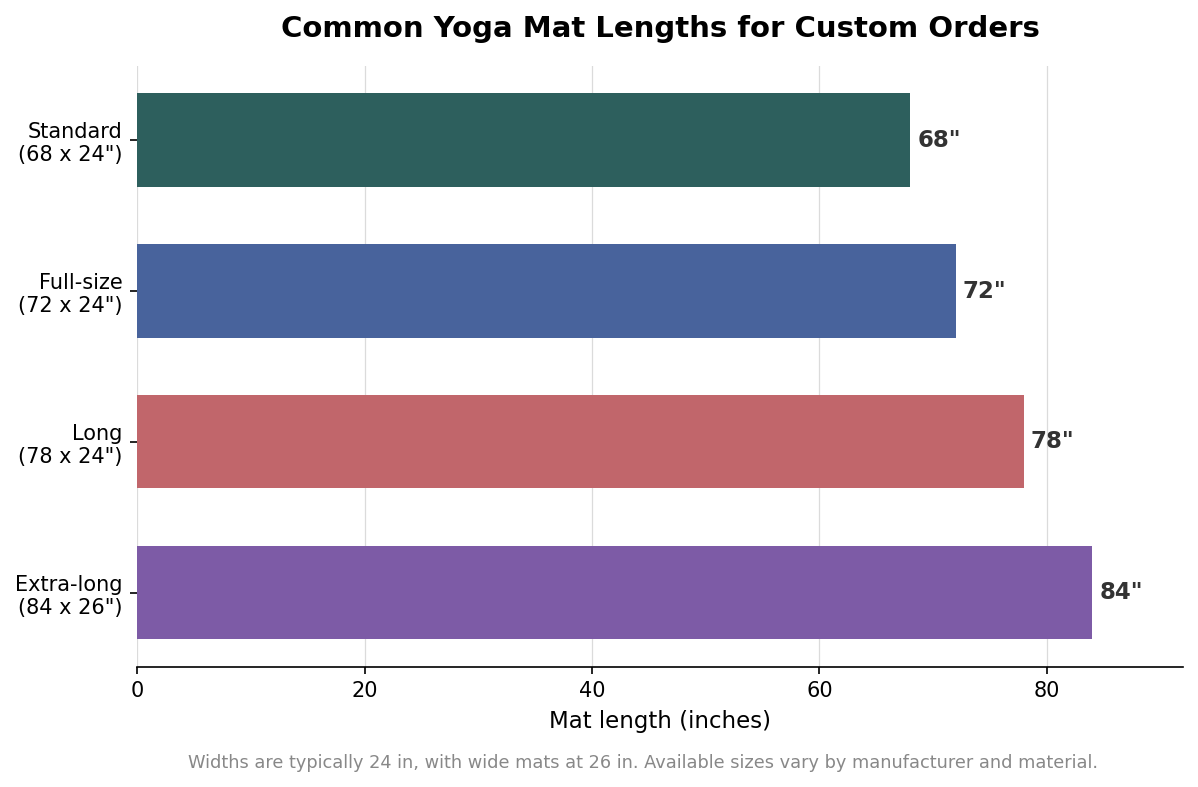
    Horizontal bar chart of common yoga mat lengths: standard 68 inches, full-size 72, long 78, extra-long 84 inches
    Common mat lengths for custom orders, from the 68-inch standard up to 84-inch extra-long.

    What thickness means when you order in bulk

    For a personal purchase, thickness is about comfort. For a bulk custom order, it is also about logistics and cost. Thicker mats weigh more and take more space, so they raise freight and storage on a pallet of a few hundred units, and they are harder to ship to customers if you are a retail brand fulfilling online orders. Thinner mats ship cheaply and store flat but give your buyers less padding, which can drive returns if the product page oversells the comfort. The pragmatic path for most branded programs is to standardize on a 3 to 4 millimeter mat in a length a little over 68 inches, treat grip and print surface as a separate decision, and reserve the thicker tiers for a deliberately positioned premium or restorative line rather than the default. That keeps the catalog simple, the freight predictable, and the product honest about what it does on the floor.
  • How to Specify a Custom Yoga Mat: Surface, Print Method, and Artwork

    How to Specify a Custom Yoga Mat: Surface, Print Method, and Artwork

    Specifying a custom yoga mat comes down to four decisions made in the right order: the surface material, the print method, the thickness, and the artwork prep. Buyers who choose a design first and a material second usually discover too late that their photographic full-bleed graphic cannot live on the natural-rubber mat they picked. Get the sequence right and you avoid reprints, color surprises, and blown deadlines.

    Start with the surface, because it dictates everything downstream

    The single most consequential choice is what the top of the mat is made of, because that surface decides which decoration methods are even possible. Full-color, edge-to-edge printing relies on dye sublimation, and sublimation needs a print-receptive top layer, typically a microfiber or suede-textured polyurethane skin bonded to a rubber base, or a coated PVC surface. On those materials, ink turns to gas and bonds into the fibers, so the graphic is baked in rather than sitting on top.

    Natural rubber, cork, and jute behave differently. Their surfaces do not accept sublimation well, so they are usually branded by laser engraving or by screen-printing a small number of spot colors. That is perfect for a clean logo or a single-color mark, and it keeps the tactile, matte character many practitioners prefer, but it will not reproduce a photograph or a gradient. Deciding how ambitious your artwork is, before you fall in love with a material, is what keeps the project on track.

    Match the print method to the artwork, not the other way around

    Once the surface is settled, the print method follows from the complexity of the design. A single logo or a one-to-two color mark is best handled by screen printing or engraving: setup is cheaper, durability is excellent, and the look is understated. A full-color wrap, a mandala that runs off all four edges, or a photographic background calls for dye sublimation on a receptive top layer.

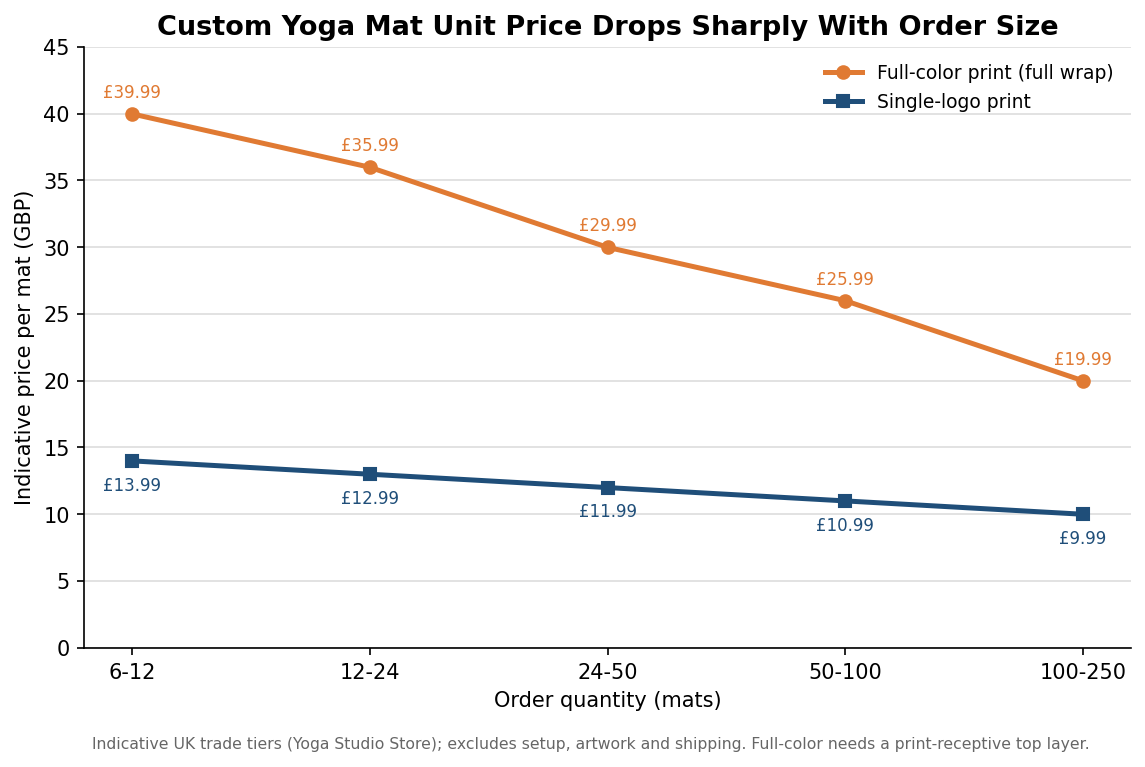
    The cost difference is real and worth planning around. Indicative UK trade pricing shows single-logo mats landing around £13.99 each at small quantities and easing toward £9.99 as volumes climb past a hundred, while a full-color print runs closer to £39.99 at the smallest tier and settles near £19.99 in the hundreds. The shape of that curve matters more than the exact figures: both methods reward larger runs, but full-color carries a persistent premium because it uses more ink, more press time, and a specialized substrate.

    Line chart comparing indicative per-mat price for single-logo versus full-color printed yoga mats across order quantity tiers
    Both decoration routes reward volume, but full-color printing carries a steady premium over a single-logo mark.

    The practical takeaway is to be honest about how much color your brand actually needs. A studio that wants its wordmark in one color on a warm cork mat is buying a very different product from a retail brand selling a photographic hero mat, and conflating the two is where budgets go wrong.

    Choose thickness for the practice, not by habit

    Thickness is where buyers most often default to a number without thinking about the practice it serves. Common options run 3, 4, 5, 6, and 8 millimeters, and each trades cushioning against stability. A 4 mm mat is the versatile middle ground: enough padding for most flow and vinyasa work while keeping a stable connection to the floor for balance poses. A 6 mm mat adds cushioning that suits restorative, therapeutic, and joint-sensitive users, at the cost of a slightly less grounded feel in standing balances. A 3 mm mat is thin and firm, favored for alignment-focused practice and for travel because it folds and weighs less.

    Material and thickness interact with grip, too. A PVC mat needs a textured or tacky top to grip once hands get sweaty, while a rubber or PU mat often grips better wet than dry. If your buyers include hot-yoga studios, weight the decision toward surfaces and toppings that perform under moisture rather than toward raw thickness.

    Prepare artwork so the physical proof matches the screen

    Sublimation is unforgiving of vague files, so build artwork at the final printed size rather than scaling a small graphic up. For large-format sublimation, aim for roughly 150 dpi at full size as a working target, supply vector art where the design is logo-based, and set up files in CMYK so you are designing in the color space the press actually uses. Colors almost always read slightly softer and warmer on a textured, matte mat than on a glowing monitor, so treat the screen as a rough guide and the physical proof as the truth.

    Two details save the most grief. First, account for bleed and wrap: extend the background past the trim so no white slivers appear at the edges, and keep logos and text inside a safe margin so nothing critical lands in the wrap or gets clipped. Second, order a pre-production sample of the actual mat with your actual artwork before committing to the full run. A digital proof confirms layout; only a physical sample confirms how your specific colors sit on that specific surface.

    Build the timeline backward from the date you need mats in hand

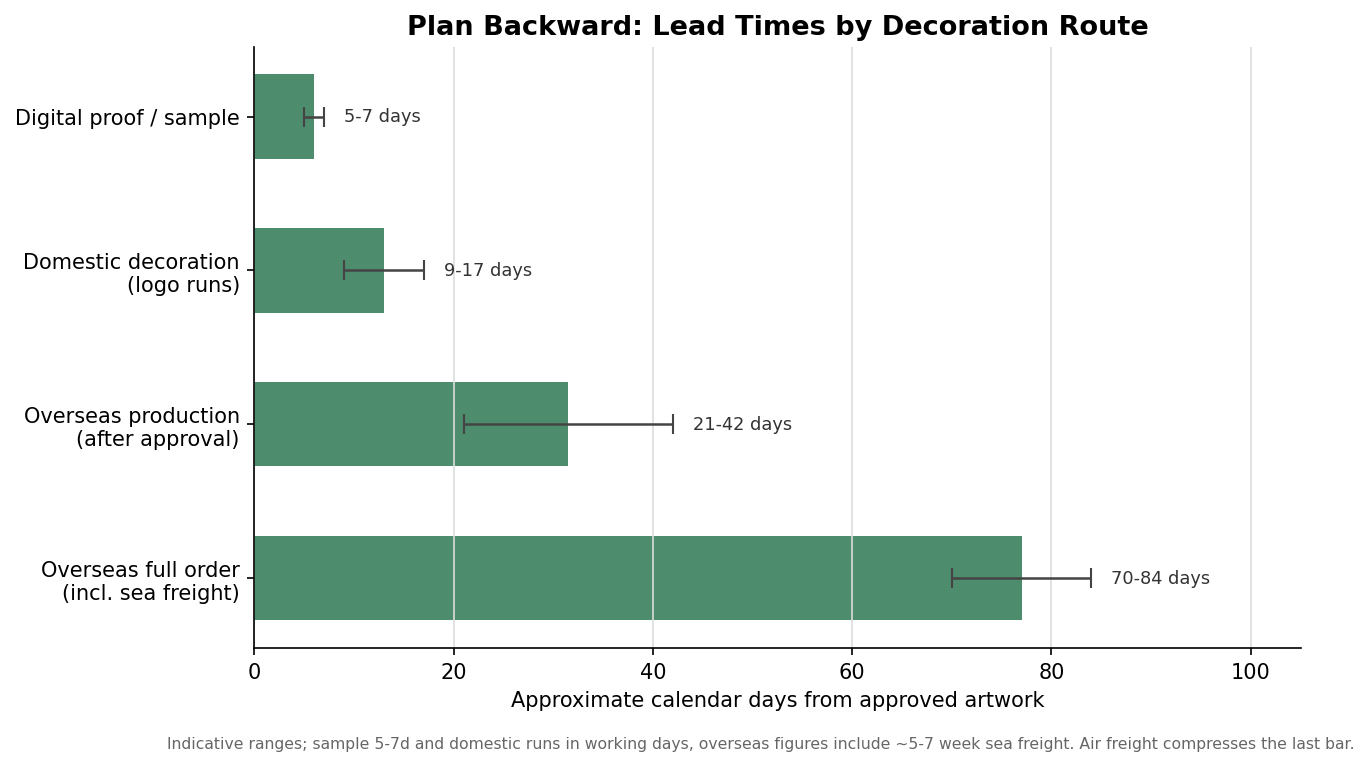
    Lead time is the quietest cause of disappointment, because it is invisible until it is too late. The pieces stack up: a digital proof and physical sample typically take about 5 to 7 days, a domestic decoration run of logo mats often lands in 7 to 12 working days, and an overseas custom order commonly needs 15 to 30 days of production after artwork approval, plus transit. When those overseas mats travel by sea, the door-to-door timeline stretches to roughly 10 to 12 weeks. Air freight compresses the tail but adds cost.

    Horizontal bar chart of approximate lead times in days for sample, domestic decoration, overseas production, and overseas full order with sea freight
    Indicative lead times by route; the sea-freight tail is what most often surprises first-time buyers.

    Minimums track the same split. Domestic decorators will often run small quantities, with price tiers starting as low as six to twelve mats, while overseas factories that mold and print from scratch usually want a minimum around 600 pieces to justify tooling and setup. If you need a modest number of branded mats for an event next month, a domestic logo run is the realistic path; if you are launching a product line and can order in bulk with lead time to spare, overseas full-color manufacturing unlocks the lower per-unit pricing.

    Specify in that order, then, and the rest falls into place: pick the surface that supports the artwork you want, choose the print method your design actually requires, set thickness by the practice you are serving, prepare files at full size in the right color space, and count backward from your deadline with a sample built into the schedule. Each decision constrains the next, which is exactly why the sequence, not any single choice, is what separates a clean first run from an expensive second one.

  • Common Mistakes When Ordering Custom-Printed Yoga Mats (and How to Avoid Them)

    Common Mistakes When Ordering Custom-Printed Yoga Mats (and How to Avoid Them)

    Most problems with a custom yoga mat order are decided before anything is printed. The artwork usually looks fine on screen; what goes wrong is the physical specification underneath it, the surface people actually practice on, and the small print about weight, quantities, and lead time. These are the mistakes that come up most often when ordering custom-printed mats, and how to head each one off.

    Choosing thickness for feel alone

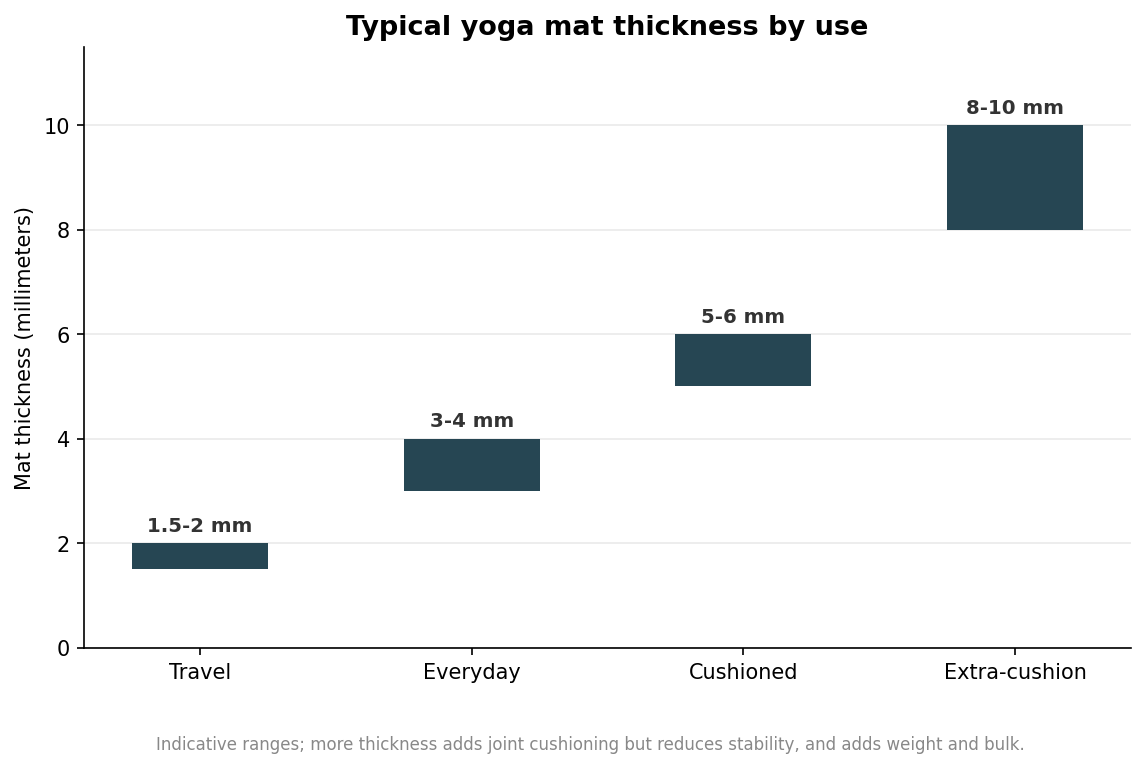
    Thickness is the first spec buyers pick and the one they most often get backwards, because more is not simply better. Travel mats run about 1.5 to 2 millimeters and fold small but offer little joint protection. Everyday studio mats sit around 3 to 4 millimeters, the balance most practices want. Cushioned mats at 5 to 6 millimeters ease pressure on knees and spine, and extra-cushion options of 8 millimeters and up feel plush but trade away stability. The catch is balance. A thick, soft mat that is kind to joints in a floor sequence becomes wobbly in standing balance poses, and it weighs and packs bigger. Match the thickness to how the mat will actually be used rather than defaulting to the plushest option, and remember every added millimeter is also added weight to carry. Size interacts with this too: standard mats run about 68 by 24 inches, with longer 72-to-74-inch options for taller practitioners and extra-large mats up to around 84 inches, and a bigger footprint again means more material weight and higher cost per unit.

    Range column chart of typical yoga mat thickness in millimeters for travel, everyday, cushioned and extra-cushion mats
    Typical thickness ranges by use; more cushioning trades away stability and adds weight.

    Confusing the print surface with the grip surface

    Full-color, edge-to-edge custom mats are almost always made by dye sublimating the design into a polyester microfiber suede top, which is then bonded to a rubber base. That construction is what makes vivid all-over printing possible, but it also changes how the mat behaves. A suede microfiber top is absorbent. It grips beautifully once there is a little moisture on it, which is why it suits hot and sweaty practice, but it can feel slick when completely dry until it is lightly misted or broken in, and because it soaks up sweat it needs regular washing, usually a gentle hand or machine wash and air drying, since harsh heat can loosen the bond between the printed top and the rubber base. This is a different feel from a closed-cell PVC mat, which wipes clean in seconds but can turn slippery under sweat. Neither is wrong, but buyers who expect a printed mat to behave like their old wipe-clean PVC mat are often surprised. Decide whether the practice is dry or sweaty first, and choose the surface to match.

    Under-specifying the material and over-trusting eco claims

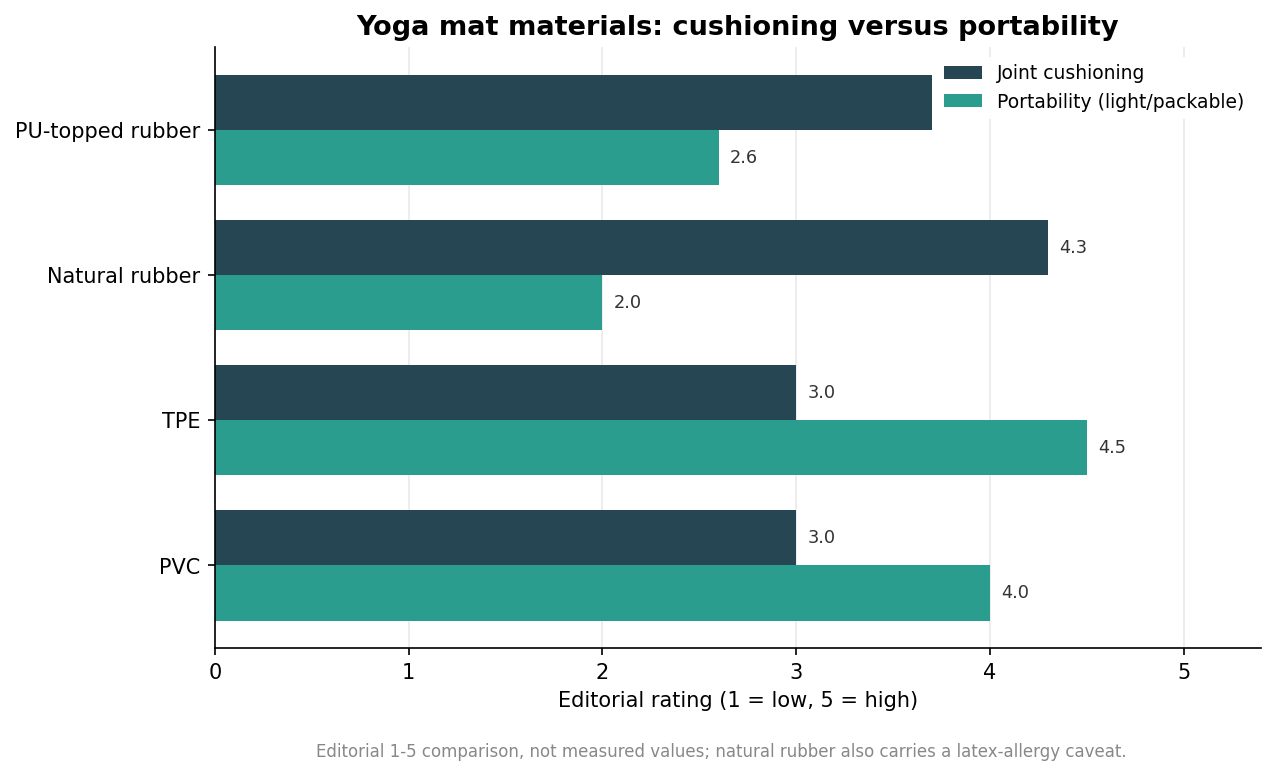
    The base material sets durability, grip, weight, and environmental profile, and leaving it vague invites substitutions. PVC is durable and easy to clean but is not a natural material and, in cheap versions, can raise questions about phthalates. TPE is lighter and often marketed as more recyclable, but tends to be less hard-wearing. Natural rubber offers excellent grip and cushioning and a genuine eco story, at the cost of more weight, a noticeable initial smell, and a real latex-allergy concern worth disclosing to buyers. Polyurethane tops give outstanding wet grip and a premium feel but scuff more easily. Treat unqualified “eco,” “non-toxic,” or “natural” labels as marketing, not proof. If safety or sustainability matters to your audience, ask the supplier for specifics such as OEKO-TEX certification or documented compliance with Proposition 65 and REACH, and get it in writing rather than accepting a logo on a listing.

    Grouped horizontal bar chart comparing PVC, TPE, natural rubber and PU-topped rubber on joint cushioning versus portability
    An editorial comparison of common mat materials on cushioning versus portability.

    Sending artwork that fights the process

    Sublimation onto suede is forgiving of detail but not of color assumptions. Designs built in bright screen RGB often print more muted than expected, because the dye sits in a soft textile rather than on glossy paper, so work in CMYK and, where color accuracy matters, ask for a printed proof rather than trusting the on-screen mockup. Build the file at full size with real bleed past the trim edge, since a mat trimmed with no bleed can show a thin unprinted line along the border. Use high-resolution art, because a logo that looks crisp on a phone can turn soft when stretched across a 68-inch mat. Very dark, saturated fields also show lint, wear, and footprints more readily than mid-tones, which is worth weighing for a mat that will be used hard.

    Overlooking weight, minimums, and lead time

    The commercial details derail more orders than the design ever does. A microfiber-and-rubber mat typically weighs somewhere around 2 to 3.5 pounds, while a solid natural rubber mat can run heavier, which matters for a mat people carry daily and for your shipping costs at volume. Minimum order quantities swing widely: print-on-demand services will make a single mat, while bulk custom manufacturing often starts around fifty to a hundred units per design and rewards larger runs with better pricing. Lead times commonly land in the two-to-four-week range for domestic printing and stretch longer for overseas bulk production, so build in slack before an event or launch date. Above all, order a single sample before committing to the full run. The sample confirms the color, the thickness, the grip, and the smell in a way no screen preview can, and it is far cheaper than discovering a problem across a pallet of finished mats. The figures here are indicative and vary by supplier; use them to ask sharper questions, not as a quote.