Specifying a custom yoga mat comes down to four decisions made in the right order: the surface material, the print method, the thickness, and the artwork prep. Buyers who choose a design first and a material second usually discover too late that their photographic full-bleed graphic cannot live on the natural-rubber mat they picked. Get the sequence right and you avoid reprints, color surprises, and blown deadlines.
Start with the surface, because it dictates everything downstream
The single most consequential choice is what the top of the mat is made of, because that surface decides which decoration methods are even possible. Full-color, edge-to-edge printing relies on dye sublimation, and sublimation needs a print-receptive top layer, typically a microfiber or suede-textured polyurethane skin bonded to a rubber base, or a coated PVC surface. On those materials, ink turns to gas and bonds into the fibers, so the graphic is baked in rather than sitting on top.
Natural rubber, cork, and jute behave differently. Their surfaces do not accept sublimation well, so they are usually branded by laser engraving or by screen-printing a small number of spot colors. That is perfect for a clean logo or a single-color mark, and it keeps the tactile, matte character many practitioners prefer, but it will not reproduce a photograph or a gradient. Deciding how ambitious your artwork is, before you fall in love with a material, is what keeps the project on track.
Match the print method to the artwork, not the other way around
Once the surface is settled, the print method follows from the complexity of the design. A single logo or a one-to-two color mark is best handled by screen printing or engraving: setup is cheaper, durability is excellent, and the look is understated. A full-color wrap, a mandala that runs off all four edges, or a photographic background calls for dye sublimation on a receptive top layer.
The cost difference is real and worth planning around. Indicative UK trade pricing shows single-logo mats landing around £13.99 each at small quantities and easing toward £9.99 as volumes climb past a hundred, while a full-color print runs closer to £39.99 at the smallest tier and settles near £19.99 in the hundreds. The shape of that curve matters more than the exact figures: both methods reward larger runs, but full-color carries a persistent premium because it uses more ink, more press time, and a specialized substrate.
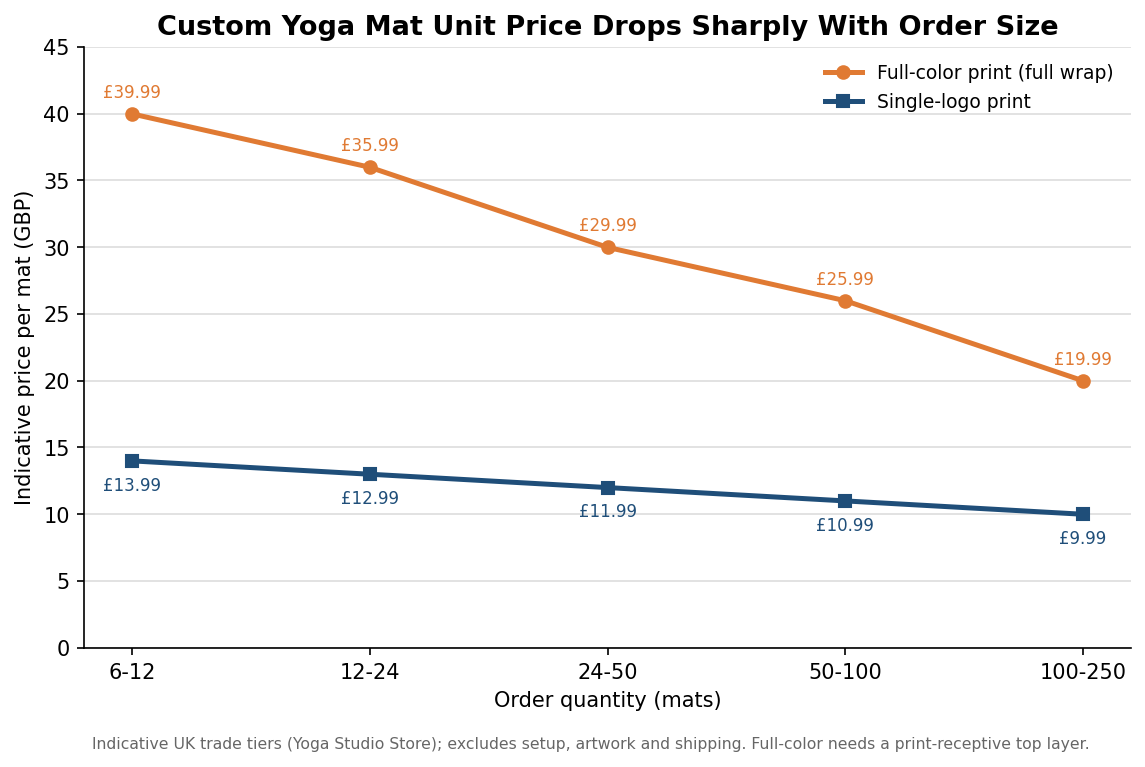
The practical takeaway is to be honest about how much color your brand actually needs. A studio that wants its wordmark in one color on a warm cork mat is buying a very different product from a retail brand selling a photographic hero mat, and conflating the two is where budgets go wrong.
Choose thickness for the practice, not by habit
Thickness is where buyers most often default to a number without thinking about the practice it serves. Common options run 3, 4, 5, 6, and 8 millimeters, and each trades cushioning against stability. A 4 mm mat is the versatile middle ground: enough padding for most flow and vinyasa work while keeping a stable connection to the floor for balance poses. A 6 mm mat adds cushioning that suits restorative, therapeutic, and joint-sensitive users, at the cost of a slightly less grounded feel in standing balances. A 3 mm mat is thin and firm, favored for alignment-focused practice and for travel because it folds and weighs less.
Material and thickness interact with grip, too. A PVC mat needs a textured or tacky top to grip once hands get sweaty, while a rubber or PU mat often grips better wet than dry. If your buyers include hot-yoga studios, weight the decision toward surfaces and toppings that perform under moisture rather than toward raw thickness.
Prepare artwork so the physical proof matches the screen
Sublimation is unforgiving of vague files, so build artwork at the final printed size rather than scaling a small graphic up. For large-format sublimation, aim for roughly 150 dpi at full size as a working target, supply vector art where the design is logo-based, and set up files in CMYK so you are designing in the color space the press actually uses. Colors almost always read slightly softer and warmer on a textured, matte mat than on a glowing monitor, so treat the screen as a rough guide and the physical proof as the truth.
Two details save the most grief. First, account for bleed and wrap: extend the background past the trim so no white slivers appear at the edges, and keep logos and text inside a safe margin so nothing critical lands in the wrap or gets clipped. Second, order a pre-production sample of the actual mat with your actual artwork before committing to the full run. A digital proof confirms layout; only a physical sample confirms how your specific colors sit on that specific surface.
Build the timeline backward from the date you need mats in hand
Lead time is the quietest cause of disappointment, because it is invisible until it is too late. The pieces stack up: a digital proof and physical sample typically take about 5 to 7 days, a domestic decoration run of logo mats often lands in 7 to 12 working days, and an overseas custom order commonly needs 15 to 30 days of production after artwork approval, plus transit. When those overseas mats travel by sea, the door-to-door timeline stretches to roughly 10 to 12 weeks. Air freight compresses the tail but adds cost.
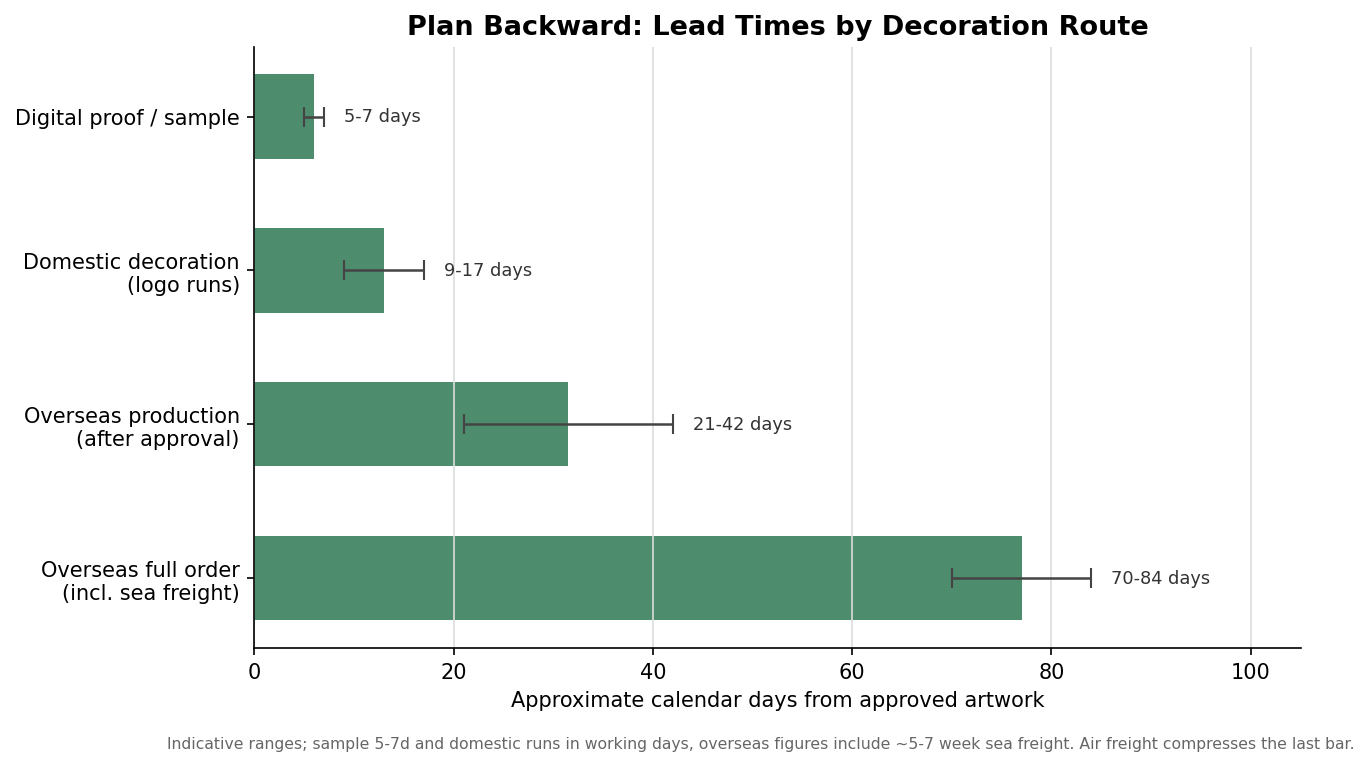
Minimums track the same split. Domestic decorators will often run small quantities, with price tiers starting as low as six to twelve mats, while overseas factories that mold and print from scratch usually want a minimum around 600 pieces to justify tooling and setup. If you need a modest number of branded mats for an event next month, a domestic logo run is the realistic path; if you are launching a product line and can order in bulk with lead time to spare, overseas full-color manufacturing unlocks the lower per-unit pricing.
Specify in that order, then, and the rest falls into place: pick the surface that supports the artwork you want, choose the print method your design actually requires, set thickness by the practice you are serving, prepare files at full size in the right color space, and count backward from your deadline with a sample built into the schedule. Each decision constrains the next, which is exactly why the sequence, not any single choice, is what separates a clean first run from an expensive second one.
Leave a Reply