Thickness is the first spec people obsess over when they buy a yoga mat and the one they most often get wrong. It is measured in millimeters, it ranges from about 1.5 up past 10, and there is no single right answer, because thickness controls a trade-off rather than a quality level. Understanding that trade-off is what lets a studio, a retail brand, or an event organizer pick a mat that people actually want to stand on.
The one trade-off that governs everything
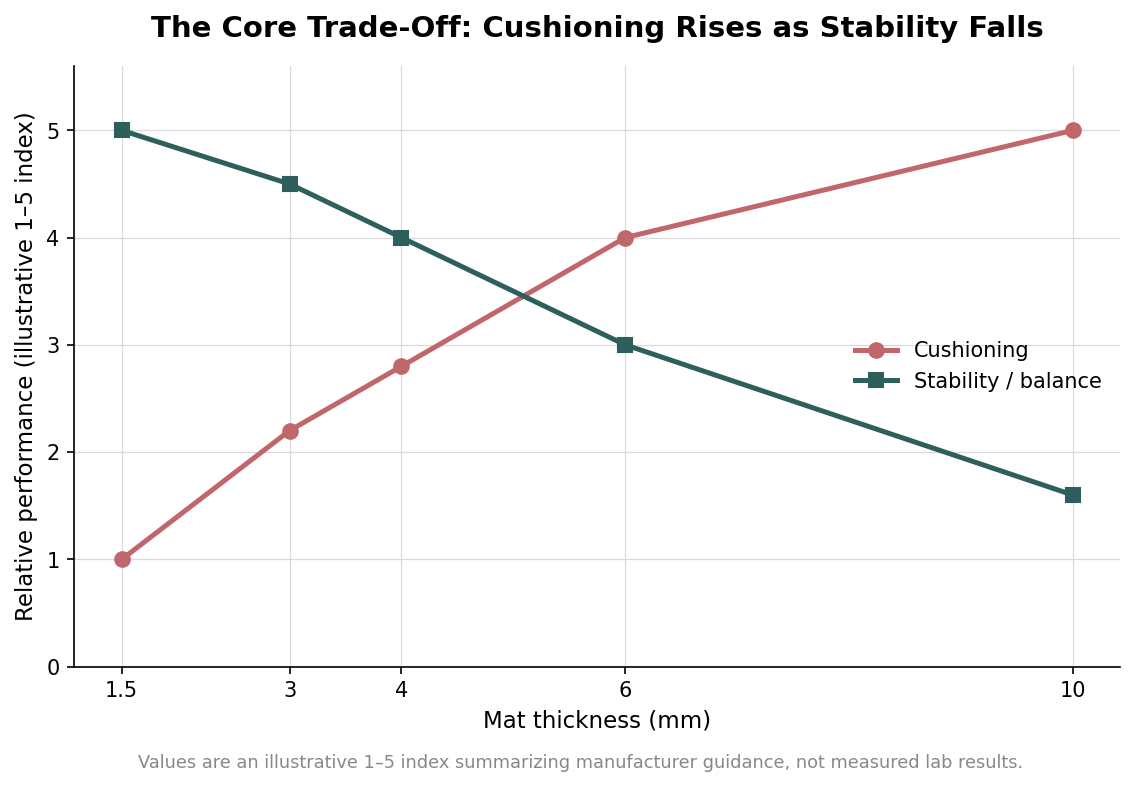
Every millimeter you add to a mat does two things at once: it adds cushioning under the knees, wrists, and spine, and it takes away stability underfoot. A thin mat puts you almost directly on the floor, which is exactly what you want in a standing balance or a flowing sequence, because you can feel the ground and your ankles have a firm base. A thick mat feels plush in a kneeling stretch but turns wobbly the moment you try to hold tree pose on it, because your foot sinks into foam that keeps moving. You cannot buy your way out of this with a better material; it is a physical consequence of putting more compressible foam between the body and the floor.
That is why the honest way to choose is to decide which side of the trade-off your practice lives on, and then buy the thinnest mat that still protects the joints you care about. Most people over-buy on cushioning and then quietly struggle with balance for months.
The thickness tiers, and who each one is for
Around 1.5 to 2 millimeters is travel territory. These mats fold or roll small enough for a backpack and give maximum stability, but they offer little padding, so a bare wood or concrete floor will be hard on the knees. They suit commuters and anyone laying a personal layer over a studio’s own mats.
Three to four millimeters is the workhorse standard, and it is where most serious practice happens. It balances enough cushioning for everyday postures against enough firmness for standing work and inversions, which is why it is the default for flow styles and hot yoga. If you are outfitting a studio and want one thickness that offends no one, this is it.
Five to six millimeters is the comfort tier. It protects sensitive joints and suits restorative and gentle practice, at the cost of some balance and noticeably more weight and bulk. High-density versions resist the dreaded feeling of bottoming out, where the foam compresses fully and you feel the floor through it anyway. Eight to ten millimeters and up crosses into Pilates and general fitness use; it is genuinely too soft and bulky for standing yoga balances, and it is heavy to carry and store.
Millimeters alone do not tell the whole story, because density changes what a given thickness feels like. A dense natural-rubber mat at 4 millimeters can feel firmer and more supportive than a soft foam mat at 6, and it will usually weigh more for the same dimensions. That is why comparing two mats purely on their stated thickness can mislead you: a low-density mat pads the specification sheet without padding your knees, and it is the mats that compress to nothing under load that generate the most complaints. When you can, judge a sample by pressing it under your full body weight rather than by the number on the label.
Thickness is not grip, and confusing the two costs money
A recurring mistake is assuming a thicker mat grips better. It does not. Grip comes from the surface material and its texture, not from how much foam sits underneath. A 3 millimeter mat with a well-textured or rubber top can hold a sweaty hand far better than a soft 8 millimeter mat with a slick surface. For a custom-printed mat this distinction matters even more, because the print sits on the top surface, and the choice of that top layer drives both how the artwork looks and how well the mat holds a pose. Decide grip and print surface as their own spec, separate from thickness, rather than assuming one solves the other.
Sizing rides alongside thickness
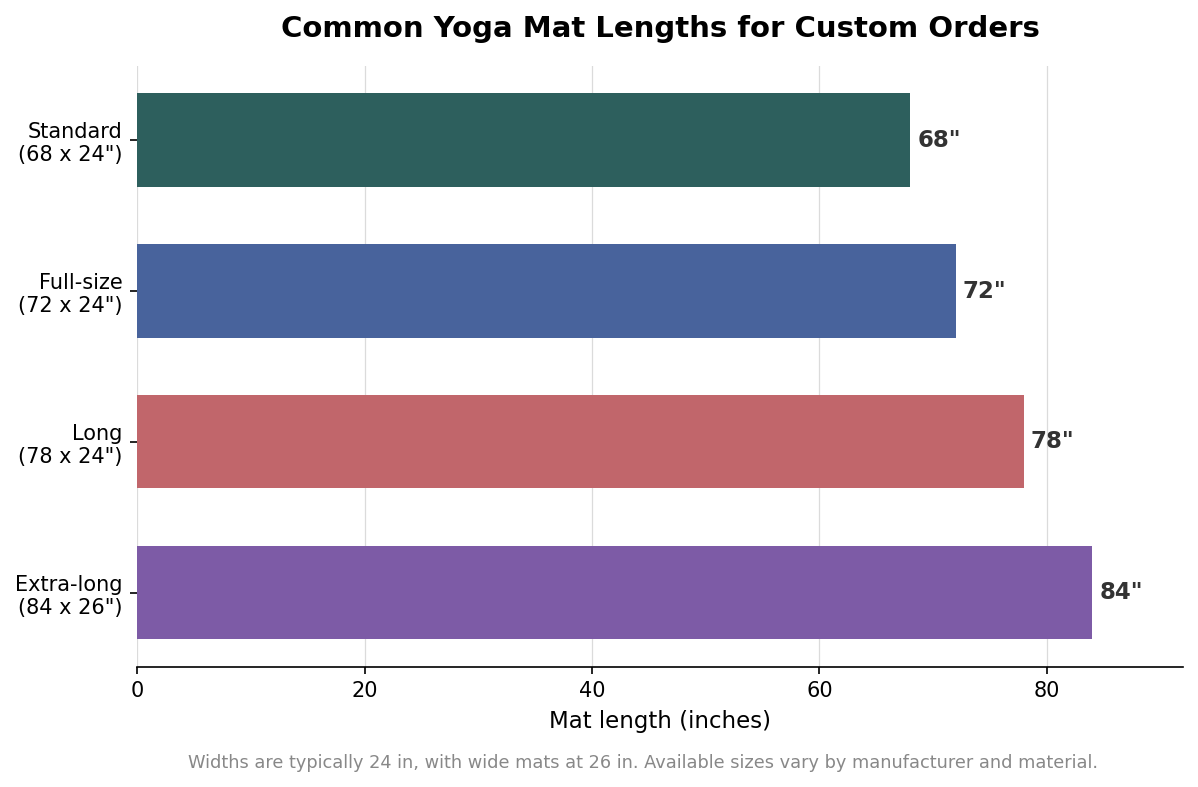
Length is the spec buyers forget until a tall member’s heels hang off the end. The traditional standard is about 68 by 24 inches, which fits average heights, while full-size mats run to roughly 72 by 24 inches for taller practitioners. Long and extra-long options reach 78 to 84 inches, and wide mats step out to 26 inches for more lateral room. For a studio or brand ordering in bulk, choosing a slightly longer standard than 68 inches is a cheap way to fit a wider range of bodies without stocking multiple lengths.
What thickness means when you order in bulk
For a personal purchase, thickness is about comfort. For a bulk custom order, it is also about logistics and cost. Thicker mats weigh more and take more space, so they raise freight and storage on a pallet of a few hundred units, and they are harder to ship to customers if you are a retail brand fulfilling online orders. Thinner mats ship cheaply and store flat but give your buyers less padding, which can drive returns if the product page oversells the comfort. The pragmatic path for most branded programs is to standardize on a 3 to 4 millimeter mat in a length a little over 68 inches, treat grip and print surface as a separate decision, and reserve the thicker tiers for a deliberately positioned premium or restorative line rather than the default. That keeps the catalog simple, the freight predictable, and the product honest about what it does on the floor.
Leave a Reply