Thickness is the first spec people obsess over when they buy a yoga mat and the one they most often get wrong. It is measured in millimeters, it ranges from about 1.5 up past 10, and there is no single right answer, because thickness controls a trade-off rather than a quality level. Understanding that trade-off is what lets a studio, a retail brand, or an event organizer pick a mat that people actually want to stand on.
The one trade-off that governs everything
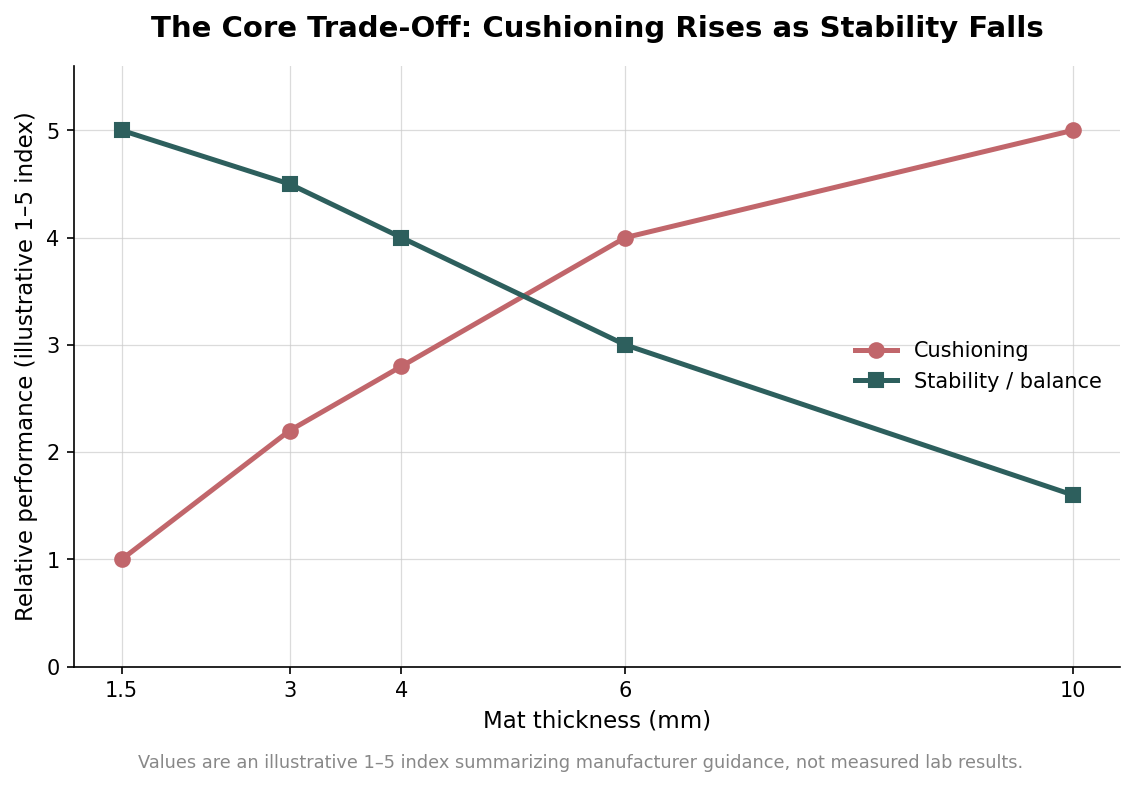
Every millimeter you add to a mat does two things at once: it adds cushioning under the knees, wrists, and spine, and it takes away stability underfoot. A thin mat puts you almost directly on the floor, which is exactly what you want in a standing balance or a flowing sequence, because you can feel the ground and your ankles have a firm base. A thick mat feels plush in a kneeling stretch but turns wobbly the moment you try to hold tree pose on it, because your foot sinks into foam that keeps moving. You cannot buy your way out of this with a better material; it is a physical consequence of putting more compressible foam between the body and the floor.
That is why the honest way to choose is to decide which side of the trade-off your practice lives on, and then buy the thinnest mat that still protects the joints you care about. Most people over-buy on cushioning and then quietly struggle with balance for months.
Adding thickness trades stability for cushioning; the two move in opposite directions across the range.
The thickness tiers, and who each one is for
Around 1.5 to 2 millimeters is travel territory. These mats fold or roll small enough for a backpack and give maximum stability, but they offer little padding, so a bare wood or concrete floor will be hard on the knees. They suit commuters and anyone laying a personal layer over a studio’s own mats.
Three to four millimeters is the workhorse standard, and it is where most serious practice happens. It balances enough cushioning for everyday postures against enough firmness for standing work and inversions, which is why it is the default for flow styles and hot yoga. If you are outfitting a studio and want one thickness that offends no one, this is it.
Five to six millimeters is the comfort tier. It protects sensitive joints and suits restorative and gentle practice, at the cost of some balance and noticeably more weight and bulk. High-density versions resist the dreaded feeling of bottoming out, where the foam compresses fully and you feel the floor through it anyway. Eight to ten millimeters and up crosses into Pilates and general fitness use; it is genuinely too soft and bulky for standing yoga balances, and it is heavy to carry and store.
Millimeters alone do not tell the whole story, because density changes what a given thickness feels like. A dense natural-rubber mat at 4 millimeters can feel firmer and more supportive than a soft foam mat at 6, and it will usually weigh more for the same dimensions. That is why comparing two mats purely on their stated thickness can mislead you: a low-density mat pads the specification sheet without padding your knees, and it is the mats that compress to nothing under load that generate the most complaints. When you can, judge a sample by pressing it under your full body weight rather than by the number on the label.
Thickness is not grip, and confusing the two costs money
A recurring mistake is assuming a thicker mat grips better. It does not. Grip comes from the surface material and its texture, not from how much foam sits underneath. A 3 millimeter mat with a well-textured or rubber top can hold a sweaty hand far better than a soft 8 millimeter mat with a slick surface. For a custom-printed mat this distinction matters even more, because the print sits on the top surface, and the choice of that top layer drives both how the artwork looks and how well the mat holds a pose. Decide grip and print surface as their own spec, separate from thickness, rather than assuming one solves the other.
Sizing rides alongside thickness
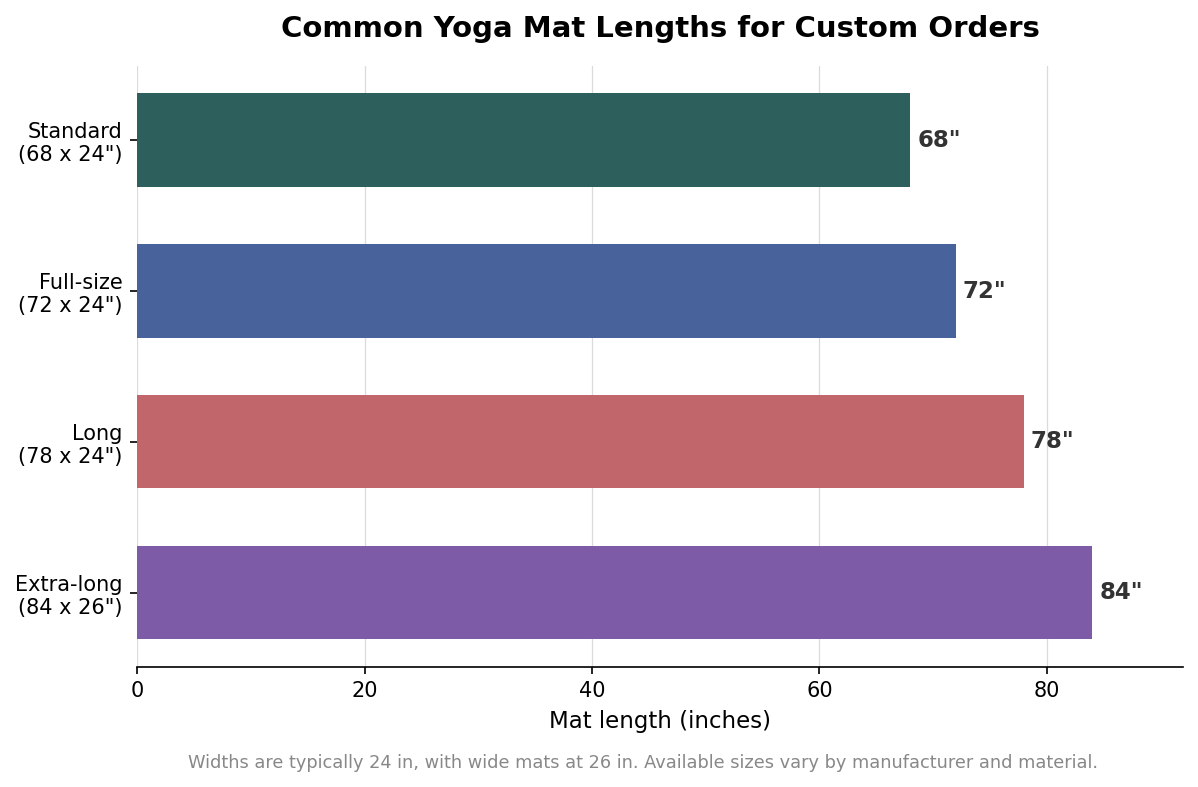
Length is the spec buyers forget until a tall member’s heels hang off the end. The traditional standard is about 68 by 24 inches, which fits average heights, while full-size mats run to roughly 72 by 24 inches for taller practitioners. Long and extra-long options reach 78 to 84 inches, and wide mats step out to 26 inches for more lateral room. For a studio or brand ordering in bulk, choosing a slightly longer standard than 68 inches is a cheap way to fit a wider range of bodies without stocking multiple lengths.
Common mat lengths for custom orders, from the 68-inch standard up to 84-inch extra-long.
What thickness means when you order in bulk
For a personal purchase, thickness is about comfort. For a bulk custom order, it is also about logistics and cost. Thicker mats weigh more and take more space, so they raise freight and storage on a pallet of a few hundred units, and they are harder to ship to customers if you are a retail brand fulfilling online orders. Thinner mats ship cheaply and store flat but give your buyers less padding, which can drive returns if the product page oversells the comfort. The pragmatic path for most branded programs is to standardize on a 3 to 4 millimeter mat in a length a little over 68 inches, treat grip and print surface as a separate decision, and reserve the thicker tiers for a deliberately positioned premium or restorative line rather than the default. That keeps the catalog simple, the freight predictable, and the product honest about what it does on the floor.
If you’ve started pricing out custom yoga mats, you’ve probably hit the same wall everyone does: half the suppliers list a number, the other half hide behind “request a quote,” and none of them make it obvious what you’re actually comparing. A $12 mat and a $35 mat can both be called “custom” — the difference is material, print coverage, and how many you’re willing to buy at once. Before you fill out another quote form, it helps to know what real pricing, minimum order quantities, and turnaround times look like across the market.
This guide pulls current listings from promotional-product resellers and factory-direct manufacturers so you can see where your order actually falls — whether you need one branded mat for a pop-up event or a few hundred for a studio launch.
Small-batch minimum (promo reseller)
~20 mats
Standard private-label TPE minimum
~100 mats
Custom cork/rubber volume tiers
100 / 300 / 500 / 1,000+
Source: Logotech.com, HTS YOGA (htsyoga.com), and EcoCorker (ecocorker.com) product and manufacturer pages, accessed August 2026
What custom yoga mats cost in 2026
Pricing for custom yoga mats splits along two lines: who’s making the mat, and how much of the surface gets printed. Promotional-product resellers who stock a base mat and add your logo tend to post the lowest entry prices, since the mat itself is a standard SKU and only the imprint changes. Factory-direct manufacturers who build the mat to your material and print spec from scratch usually cost more per unit but give you control over thickness, texture, and full-bleed graphics.
At the low end, resellers list double-layer TPE mats with a one-color imprint starting around $12 to $13 per mat before setup fees, with setup charges commonly running an extra $40 on top of the unit price. That’s the price of a mat with your logo stamped in one spot — not a full all-over print. Once you move into full-color or edge-to-edge printing, or upgrade to natural rubber or cork, per-unit pricing climbs into the $16–$28 range, and premium cork or organic-cotton builds can run $29 and up.
Entry-level custom yoga mat pricing starts around $12-13 per unit for single-color logo imprints on standard TPE or PVC mats.
Supplier listing
Entry price
What’s included
4imprint — Textured Bottom Yoga Mat, Double Layer
$12.25 per mat
Plus a $40 one-time setup charge for the imprint
QualityImprint — Custom PVC Yoga Mat (Q253411)
As low as $13.23 per mat
Base PVC mat with logo imprint, price drops at higher quantities
Entry-level custom yoga mat pricing starts around $12-13 per unit for single-color logo imprints on standard TPE or PVC mats.Source: 4imprint.com and QualityImprint.com product listings, accessed August 2026
Minimum order quantities: how many mats you have to buy
MOQ is where custom yoga mats really diverge by supplier type. Promotional resellers who already stock the base mat can sell you a small batch — some list minimums as low as 20 units, since they’re only customizing an existing product line. That’s the right lane if you need mats for a single event, a small team, or a test run before committing to a bigger buy.
Factory-direct manufacturers work differently. Because they’re mixing raw TPE, rubber, or cork and running your exact color and print spec through their own line, the setup cost has to be spread across more units. Standard-spec private-label programs on common materials often start around 100 pieces. Push into custom sizing, multiple colorways, or full-print cork and rubber builds, and volume tiers commonly step up at 100, 300, 500, and 1,000+ units, with better per-unit pricing unlocking at each tier.
Small-batch / one-off logo run: as few as 20 mats through a promo reseller
Standard private-label TPE, one color system: roughly 12 mats minimum
Custom cork, rubber, or full-print builds: volume tiers typically starting at 100 and stepping up through 1,000+
If you’re not sure which tier you need, order at the smallest MOQ your supplier offers first. It costs more per mat, but it lets you check print registration, texture, and packaging before you commit to a 500-unit run.
Lead times: how long a custom order takes
Budget more time than you think. Before bulk production even starts, most manufacturers run a pre-production sample so you can approve color match, print placement, and material feel. That sample stage typically takes 10 to 15 business days once your artwork is finalized — and it’s not optional if you’re ordering hundreds of mats, because catching a color or registration problem on one sample is a lot cheaper than catching it on a full container.
Once the sample is approved, standard bulk production for custom yoga mats runs another 25 to 35 days. Simpler builds — a single stock color with a one-location print — can move faster, while multi-color graphics, new material blends, or custom packaging add time on both ends. Add ocean freight if you’re importing from overseas, and a total order-to-doorstep timeline of 8 to 10 weeks isn’t unusual for a first-time custom run.
Sample approval alone can take up to two weeks, and standard bulk production adds another 25-35 days on top of that.
Production stage
Typical timeframe
Pre-production sample and proof approval
10-15 business days
Standard bulk production run
25-35 days
Simplified single-color SKU
Faster, factory-dependent
Sample approval alone can take up to two weeks, and standard bulk production adds another 25-35 days on top of that.Source: EcoCorker custom cork yoga mat manufacturer OEM/ODM page, accessed August 2026
Material options: TPE, natural rubber, and cork
The material you pick changes weight, grip, price, and how the mat performs in different conditions — and it’s usually the biggest lever on both cost and MOQ.
TPE vs. rubber vs. cork
TPE (thermoplastic elastomer) is the lightest and most travel-friendly option, and it’s usually latex-free, which matters if you’re selling to buyers with sensitivities. It’s also the cheapest material to source in bulk, which is why it dominates the sub-$15 entry pricing tier. Cork layered over a TPE base keeps the mat lightweight while adding a more natural, less synthetic surface texture — a common middle-ground choice for retail and home-practice buyers. Cork paired with natural rubber instead produces a denser, heavier mat with more grip under sweat, which is why studios and hot-yoga buyers tend to land there despite the added material and freight weight.
Thickness
Standard thickness options run from 3mm up to 8mm, typically with a tolerance of about ±0.3mm from the stated spec. Thinner mats (3-4mm) pack down smaller and give more floor feedback, which some practitioners prefer for balance work; thicker mats (6-8mm) add cushioning for joints but weigh more and roll up bulkier. If you’re custom-printing a design, ask your supplier how thickness affects print clarity — some textured surfaces distort fine detail more than a smooth-top mat does.
Printing methods and design considerations
How your design gets applied to the mat affects both price and durability, and it’s worth asking about specifically rather than assuming. Screen printing is the cheapest method and works well for simple logos in one or two colors, but it typically only covers a portion of the mat surface. Sublimation and UV printing allow full-color, edge-to-edge graphics — useful if you’re printing a photo, gradient, or an all-over pattern — but they cost more per unit and often push MOQs higher since the printing line needs a longer setup run to justify the changeover.
Print placement matters for how the mat wears, too. A logo printed only on the surface layer will fade faster under regular sweat and washing than a design that’s bonded into the top layer during manufacturing. If you’re ordering in volume for resale rather than a one-off giveaway, ask specifically how the supplier bonds the print to the mat and what their fade testing looks like — it’s a fair question and a legitimate one for any factory-direct order.
Choosing the right supplier for your order size
Match the supplier type to your order size rather than chasing the lowest listed price. If you need under 50 custom yoga mats — for a corporate gift run, a small studio, or a one-time event — a promotional-product reseller stocking a base mat will get you there fastest, with the lowest MOQ and the shortest lead time, even if the per-unit price is a bit higher than factory-direct.
If you’re building a retail line or outfitting a studio at scale, factory-direct OEM/ODM manufacturers make more sense once you clear the 100-unit range. You’ll get to choose the exact material blend, thickness, and print method, and the per-unit economics improve significantly at the 300, 500, and 1,000-unit tiers. The tradeoff is a longer lead time — plan for the full sample-and-production cycle, not just the production number a factory quotes you first.
Either way, get the full landed cost before comparing quotes: unit price, setup or tooling fees, packaging, and freight. A quote that looks cheaper per mat can lose that advantage entirely once a $40 setup fee or slower, costlier shipping option gets added on.
Frequently asked questions
What’s the minimum order quantity for custom yoga mats?
It depends on the supplier type. Promotional-product resellers who add your logo to a stock mat can go as low as around 20 units. Factory-direct manufacturers building to your material and print spec typically start around 100 units for standard TPE, with custom cork or rubber builds often requiring 100 to 1,000+ depending on the volume tier.
How much do custom yoga mats cost per unit?
Basic single-color logo prints on TPE or PVC mats start around $12-13 per unit before setup fees. Full-color or full-coverage printing, or upgrading to natural rubber or cork, typically runs $16-28 per unit, and premium cork or organic-cotton builds can run $29 and up.
How long does it take to get custom yoga mats made?
Plan for two stages: a pre-production sample that takes about 10-15 business days to approve, followed by standard bulk production of about 25-35 days. Add freight time if you’re importing, which can push total turnaround to 8-10 weeks for a first order.
What’s the difference between TPE, rubber, and cork yoga mats?
TPE is the lightest, most affordable, and usually latex-free. Cork layered over TPE adds natural texture while staying lightweight. Cork paired with natural rubber is the heaviest and grippiest option, commonly chosen for studio and hot-yoga use despite the added weight and cost.
Can I order just one custom yoga mat?
Some promotional-product sites sell single custom mats with no minimum, but per-unit pricing is highest at that scale. If you only need one or a handful, expect to pay closer to retail price rather than any bulk discount tier.
What thickness should I choose for a custom yoga mat?
Standard options run 3mm to 8mm with roughly ±0.3mm tolerance. Thinner mats (3-4mm) are more portable and give better floor feedback for balance-focused practice; thicker mats (6-8mm) add joint cushioning but weigh and pack down more.
The bottom line
The gap between a $12 mat and a $30 mat, or a 12-unit minimum and a 12-unit minimum, almost always comes down to who’s making it and how much of the surface you’re printing. Small orders and simple logos belong with a promotional reseller; larger runs with specific material, thickness, or full-coverage design belong with a factory-direct manufacturer willing to walk you through sample approval before bulk production starts. Whichever route you take, get unit price, setup fees, and freight in one quote before you compare suppliers — that’s the number that actually determines what your custom yoga mats cost you.
Specifying a custom yoga mat comes down to four decisions made in the right order: the surface material, the print method, the thickness, and the artwork prep. Buyers who choose a design first and a material second usually discover too late that their photographic full-bleed graphic cannot live on the natural-rubber mat they picked. Get the sequence right and you avoid reprints, color surprises, and blown deadlines.
Start with the surface, because it dictates everything downstream
The single most consequential choice is what the top of the mat is made of, because that surface decides which decoration methods are even possible. Full-color, edge-to-edge printing relies on dye sublimation, and sublimation needs a print-receptive top layer, typically a microfiber or suede-textured polyurethane skin bonded to a rubber base, or a coated PVC surface. On those materials, ink turns to gas and bonds into the fibers, so the graphic is baked in rather than sitting on top.
Natural rubber, cork, and jute behave differently. Their surfaces do not accept sublimation well, so they are usually branded by laser engraving or by screen-printing a small number of spot colors. That is perfect for a clean logo or a single-color mark, and it keeps the tactile, matte character many practitioners prefer, but it will not reproduce a photograph or a gradient. Deciding how ambitious your artwork is, before you fall in love with a material, is what keeps the project on track.
Match the print method to the artwork, not the other way around
Once the surface is settled, the print method follows from the complexity of the design. A single logo or a one-to-two color mark is best handled by screen printing or engraving: setup is cheaper, durability is excellent, and the look is understated. A full-color wrap, a mandala that runs off all four edges, or a photographic background calls for dye sublimation on a receptive top layer.
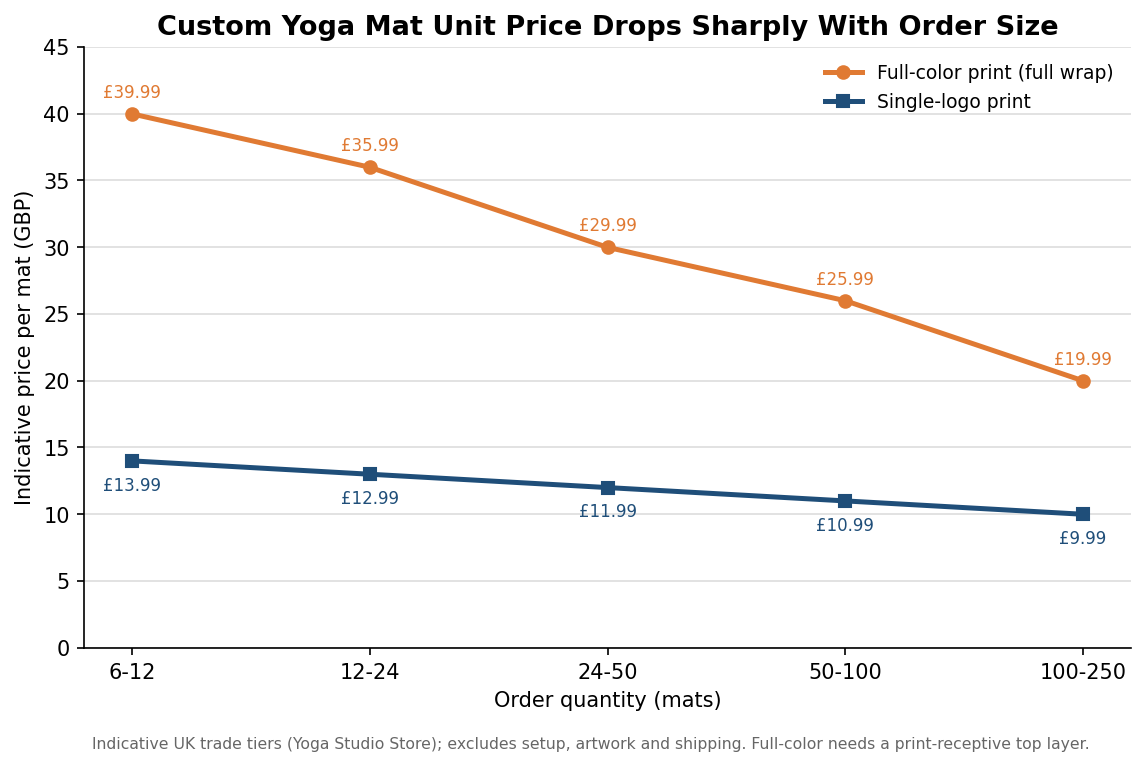
The cost difference is real and worth planning around. Indicative UK trade pricing shows single-logo mats landing around £13.99 each at small quantities and easing toward £9.99 as volumes climb past a hundred, while a full-color print runs closer to £39.99 at the smallest tier and settles near £19.99 in the hundreds. The shape of that curve matters more than the exact figures: both methods reward larger runs, but full-color carries a persistent premium because it uses more ink, more press time, and a specialized substrate.
Both decoration routes reward volume, but full-color printing carries a steady premium over a single-logo mark.
The practical takeaway is to be honest about how much color your brand actually needs. A studio that wants its wordmark in one color on a warm cork mat is buying a very different product from a retail brand selling a photographic hero mat, and conflating the two is where budgets go wrong.
Choose thickness for the practice, not by habit
Thickness is where buyers most often default to a number without thinking about the practice it serves. Common options run 3, 4, 5, 6, and 8 millimeters, and each trades cushioning against stability. A 4 mm mat is the versatile middle ground: enough padding for most flow and vinyasa work while keeping a stable connection to the floor for balance poses. A 6 mm mat adds cushioning that suits restorative, therapeutic, and joint-sensitive users, at the cost of a slightly less grounded feel in standing balances. A 3 mm mat is thin and firm, favored for alignment-focused practice and for travel because it folds and weighs less.
Material and thickness interact with grip, too. A PVC mat needs a textured or tacky top to grip once hands get sweaty, while a rubber or PU mat often grips better wet than dry. If your buyers include hot-yoga studios, weight the decision toward surfaces and toppings that perform under moisture rather than toward raw thickness.
Prepare artwork so the physical proof matches the screen
Sublimation is unforgiving of vague files, so build artwork at the final printed size rather than scaling a small graphic up. For large-format sublimation, aim for roughly 150 dpi at full size as a working target, supply vector art where the design is logo-based, and set up files in CMYK so you are designing in the color space the press actually uses. Colors almost always read slightly softer and warmer on a textured, matte mat than on a glowing monitor, so treat the screen as a rough guide and the physical proof as the truth.
Two details save the most grief. First, account for bleed and wrap: extend the background past the trim so no white slivers appear at the edges, and keep logos and text inside a safe margin so nothing critical lands in the wrap or gets clipped. Second, order a pre-production sample of the actual mat with your actual artwork before committing to the full run. A digital proof confirms layout; only a physical sample confirms how your specific colors sit on that specific surface.
Build the timeline backward from the date you need mats in hand
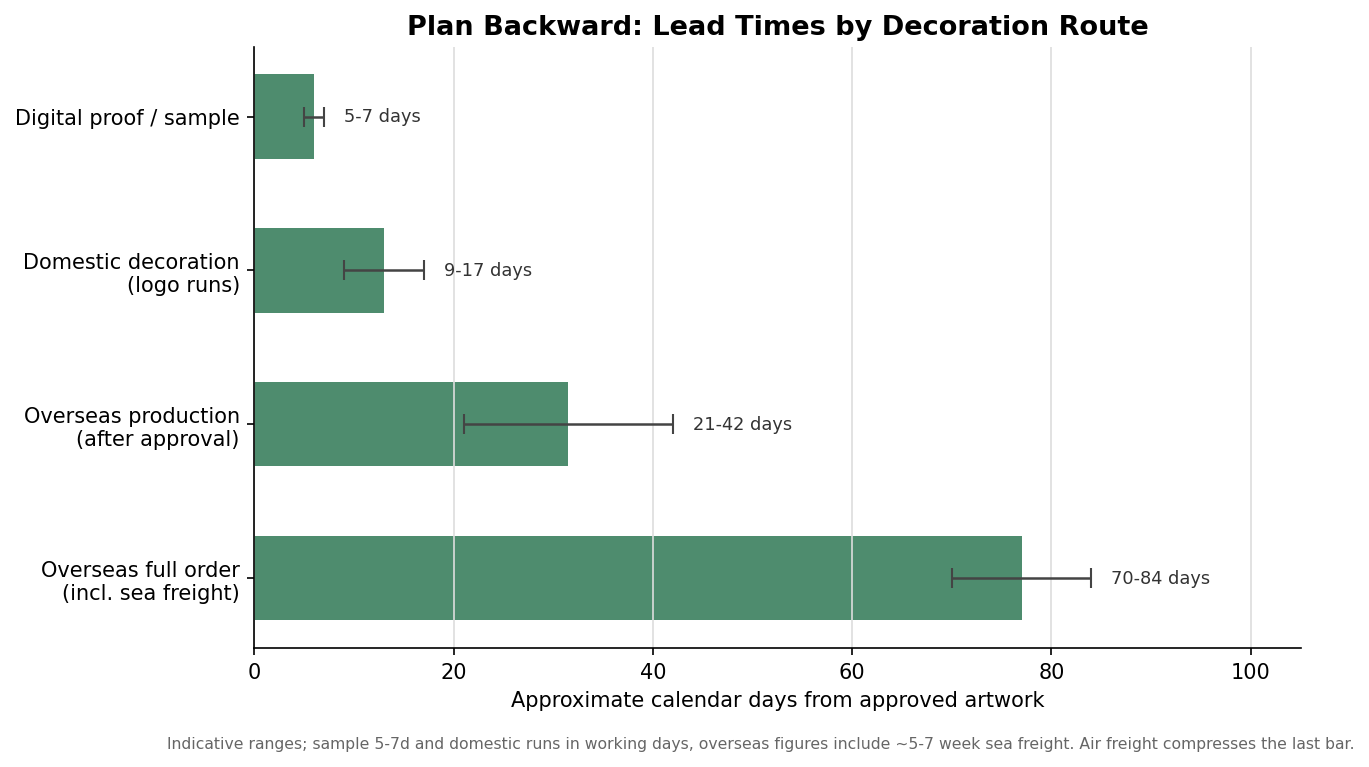
Lead time is the quietest cause of disappointment, because it is invisible until it is too late. The pieces stack up: a digital proof and physical sample typically take about 5 to 7 days, a domestic decoration run of logo mats often lands in 7 to 12 working days, and an overseas custom order commonly needs 15 to 30 days of production after artwork approval, plus transit. When those overseas mats travel by sea, the door-to-door timeline stretches to roughly 10 to 12 weeks. Air freight compresses the tail but adds cost.
Indicative lead times by route; the sea-freight tail is what most often surprises first-time buyers.
Minimums track the same split. Domestic decorators will often run small quantities, with price tiers starting as low as six to twelve mats, while overseas factories that mold and print from scratch usually want a minimum around 600 pieces to justify tooling and setup. If you need a modest number of branded mats for an event next month, a domestic logo run is the realistic path; if you are launching a product line and can order in bulk with lead time to spare, overseas full-color manufacturing unlocks the lower per-unit pricing.
Specify in that order, then, and the rest falls into place: pick the surface that supports the artwork you want, choose the print method your design actually requires, set thickness by the practice you are serving, prepare files at full size in the right color space, and count backward from your deadline with a sample built into the schedule. Each decision constrains the next, which is exactly why the sequence, not any single choice, is what separates a clean first run from an expensive second one.
Most problems with a custom yoga mat order are decided before anything is printed. The artwork usually looks fine on screen; what goes wrong is the physical specification underneath it, the surface people actually practice on, and the small print about weight, quantities, and lead time. These are the mistakes that come up most often when ordering custom-printed mats, and how to head each one off.
Choosing thickness for feel alone
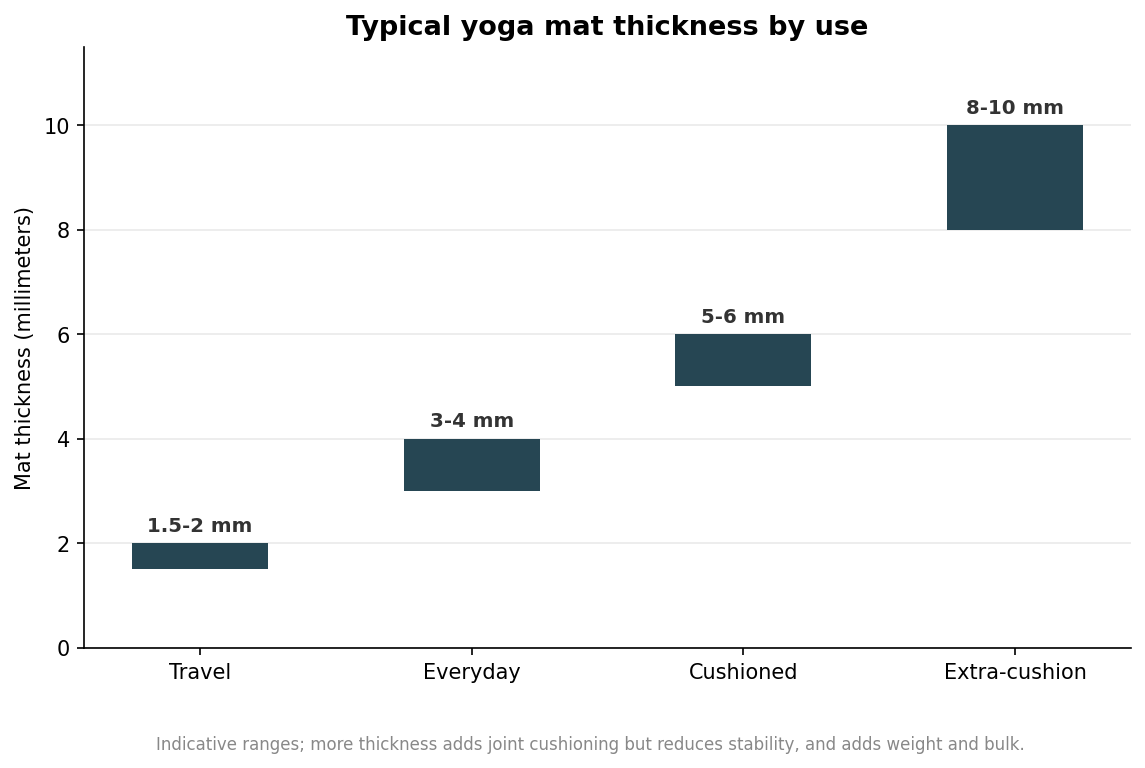
Thickness is the first spec buyers pick and the one they most often get backwards, because more is not simply better. Travel mats run about 1.5 to 2 millimeters and fold small but offer little joint protection. Everyday studio mats sit around 3 to 4 millimeters, the balance most practices want. Cushioned mats at 5 to 6 millimeters ease pressure on knees and spine, and extra-cushion options of 8 millimeters and up feel plush but trade away stability. The catch is balance. A thick, soft mat that is kind to joints in a floor sequence becomes wobbly in standing balance poses, and it weighs and packs bigger. Match the thickness to how the mat will actually be used rather than defaulting to the plushest option, and remember every added millimeter is also added weight to carry. Size interacts with this too: standard mats run about 68 by 24 inches, with longer 72-to-74-inch options for taller practitioners and extra-large mats up to around 84 inches, and a bigger footprint again means more material weight and higher cost per unit.
Typical thickness ranges by use; more cushioning trades away stability and adds weight.
Confusing the print surface with the grip surface
Full-color, edge-to-edge custom mats are almost always made by dye sublimating the design into a polyester microfiber suede top, which is then bonded to a rubber base. That construction is what makes vivid all-over printing possible, but it also changes how the mat behaves. A suede microfiber top is absorbent. It grips beautifully once there is a little moisture on it, which is why it suits hot and sweaty practice, but it can feel slick when completely dry until it is lightly misted or broken in, and because it soaks up sweat it needs regular washing, usually a gentle hand or machine wash and air drying, since harsh heat can loosen the bond between the printed top and the rubber base. This is a different feel from a closed-cell PVC mat, which wipes clean in seconds but can turn slippery under sweat. Neither is wrong, but buyers who expect a printed mat to behave like their old wipe-clean PVC mat are often surprised. Decide whether the practice is dry or sweaty first, and choose the surface to match.
Under-specifying the material and over-trusting eco claims
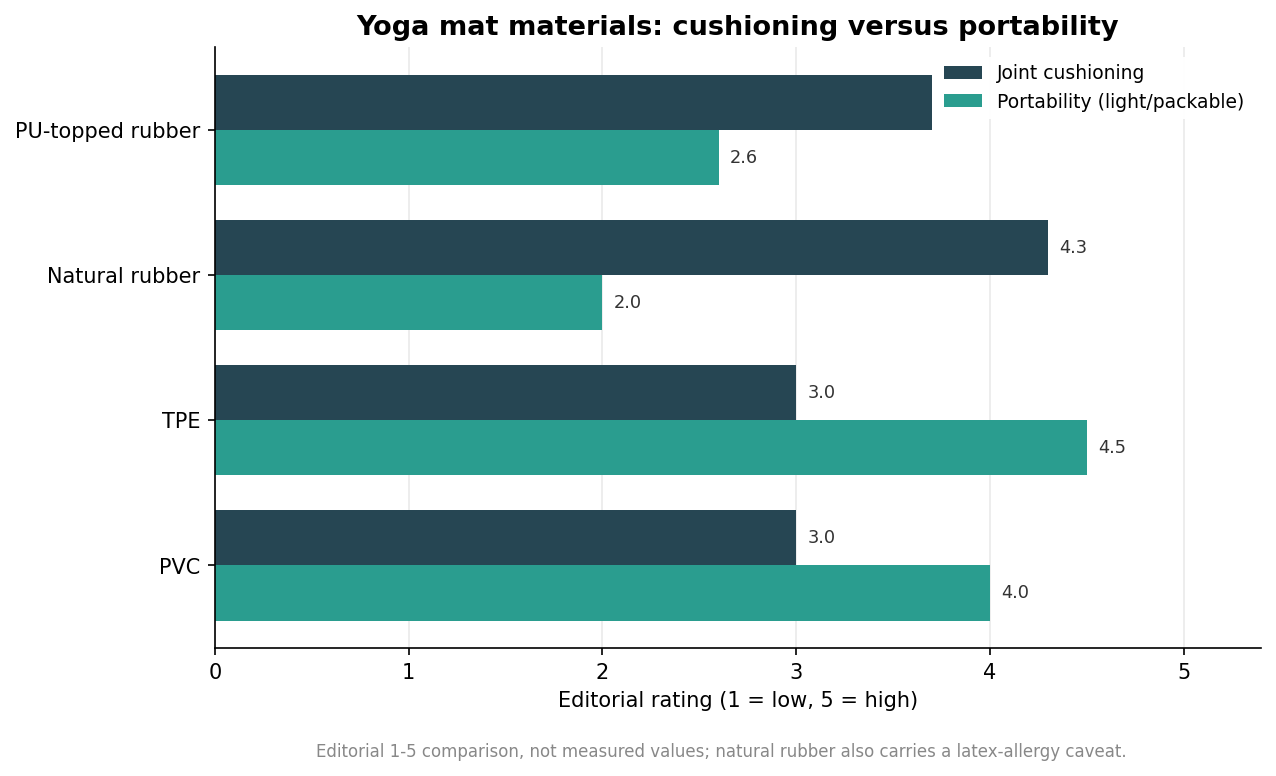
The base material sets durability, grip, weight, and environmental profile, and leaving it vague invites substitutions. PVC is durable and easy to clean but is not a natural material and, in cheap versions, can raise questions about phthalates. TPE is lighter and often marketed as more recyclable, but tends to be less hard-wearing. Natural rubber offers excellent grip and cushioning and a genuine eco story, at the cost of more weight, a noticeable initial smell, and a real latex-allergy concern worth disclosing to buyers. Polyurethane tops give outstanding wet grip and a premium feel but scuff more easily. Treat unqualified “eco,” “non-toxic,” or “natural” labels as marketing, not proof. If safety or sustainability matters to your audience, ask the supplier for specifics such as OEKO-TEX certification or documented compliance with Proposition 65 and REACH, and get it in writing rather than accepting a logo on a listing.
An editorial comparison of common mat materials on cushioning versus portability.
Sending artwork that fights the process
Sublimation onto suede is forgiving of detail but not of color assumptions. Designs built in bright screen RGB often print more muted than expected, because the dye sits in a soft textile rather than on glossy paper, so work in CMYK and, where color accuracy matters, ask for a printed proof rather than trusting the on-screen mockup. Build the file at full size with real bleed past the trim edge, since a mat trimmed with no bleed can show a thin unprinted line along the border. Use high-resolution art, because a logo that looks crisp on a phone can turn soft when stretched across a 68-inch mat. Very dark, saturated fields also show lint, wear, and footprints more readily than mid-tones, which is worth weighing for a mat that will be used hard.
Overlooking weight, minimums, and lead time
The commercial details derail more orders than the design ever does. A microfiber-and-rubber mat typically weighs somewhere around 2 to 3.5 pounds, while a solid natural rubber mat can run heavier, which matters for a mat people carry daily and for your shipping costs at volume. Minimum order quantities swing widely: print-on-demand services will make a single mat, while bulk custom manufacturing often starts around fifty to a hundred units per design and rewards larger runs with better pricing. Lead times commonly land in the two-to-four-week range for domestic printing and stretch longer for overseas bulk production, so build in slack before an event or launch date. Above all, order a single sample before committing to the full run. The sample confirms the color, the thickness, the grip, and the smell in a way no screen preview can, and it is far cheaper than discovering a problem across a pallet of finished mats. The figures here are indicative and vary by supplier; use them to ask sharper questions, not as a quote.
How to Choose Custom Yoga Mats for Your Brand: Use Cases and Ordering
The best way to choose custom yoga mats is to start from how they will be used, then work back to the material, size, and decoration that fit. Custom yoga mats serve very different jobs across trade shows & events, corporate gifting, retail & promotions, and fundraisers & teams, and matching the order to the job is what makes custom yoga mats feel purpose-built rather than generic. This guide maps the common use cases and walks through ordering custom yoga mats that fit your brand.
Whether the yoga mats protects a product, presents a gift, or carries a logo into the world, defining that job first keeps every later decision easy. Purpose drives the spec, and the spec drives the result.
How brands use custom yoga mats
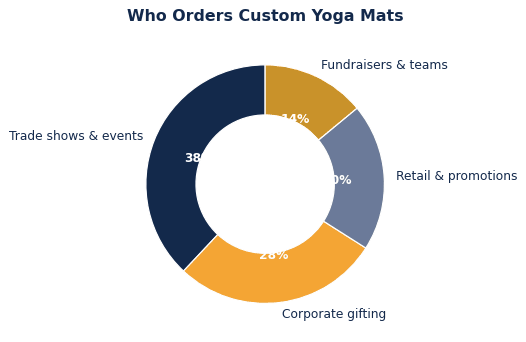
Custom yoga mats get ordered for a mix of protection, presentation, and promotion, and knowing where yours fall points you to the right build. The breakdown below shows the common uses, from trade shows & events to fundraisers & teams.
The common ways brands put custom yoga mats to work.
Most orders lean toward one primary job with a secondary benefit — a shipping-focused yoga mats that also brands the unboxing, or a gift-focused one that also protects. Naming your primary use keeps the order focused and the spec appropriate.
Use case
What it needs
Trade shows & events
memorable swag that gets picked up and kept
Corporate gifting
branded items clients and staff actually use
Retail & promotions
impulse items that carry a logo home
Fundraisers & teams
affordable branded pieces for a crowd
Matching material and size to the use
Once the use is clear, the material and size follow. A protection-first job favors a durable, well-fitted build; a presentation-first job favors a premium material and a clean print; a promotion-first job favors a cost-effective option you can order in volume. Sizing to the product with a small margin keeps the yoga mats looking intentional and performing its job.
If a single order serves more than one use, spec to the most demanding one so the yoga mats performs everywhere. It is easier to use a slightly sturdier or more premium yoga mats across the board than to discover a bargain option falls short for your most important use case.
Branding for the impression you want
Decoration should reinforce the impression the use calls for. Pad printing and full-color wraps place logos vividly, with engraving or embossing for an upscale, permanent mark. For a premium or gift use, lean on finishes and restraint; for high-volume promotion, prioritize a bold, legible logo that reads at a glance and reproduces affordably at scale. Keep branding consistent with the rest of your packaging or merch so everything reads as one system.
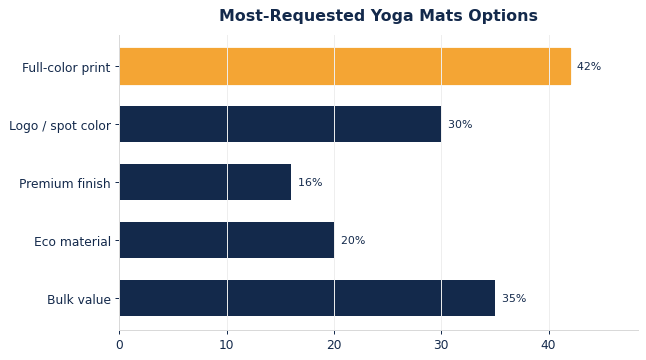
The most-requested options below reflect what buyers reach for most, and they are a useful starting menu when you brief your order. Whatever you choose, approve a proof so the finished custom yoga mats match the impression you intended.
The options buyers request most on custom yoga mats.
Getting the size and details right
Even with the use and material decided, the details are what make custom yoga mats feel finished. Confirm the size and format against the product with a small margin, check the print area for your chosen size so the logo sits cleanly, and decide on any finishing touches before you brief the order. These small confirmations up front are what separate a yoga mats that looks intentional from one that looks close-enough.
A sample or proof is the cheapest insurance you can buy on a yoga mats order. A physical sample lets you judge the material and print in hand, while a digital proof confirms artwork, color, and size and format before the full run. Spending a few minutes here prevents the far larger cost of reworking a finished order of custom yoga mats that missed on a detail.
Ordering: quantities, lead time, and reorders
A smooth yoga mats order comes down to a few basics: order for real demand plus a small overage, send print-ready artwork early, and confirm lead time against any deadline so production and shipping fit your timeline. Per-unit cost drops with volume, so consolidating a season’s needs into one run is usually more efficient than repeated small orders.
Keep your approved artwork and spec on file so reorders are a quick repeat rather than a fresh setup each time — consistency across runs keeps your brand looking deliberate.
Coordinating with the rest of your brand
Custom yoga mats rarely stand alone; they sit alongside your other packaging, print, or merch, so coordinating them strengthens the whole brand. Carrying the same logo, colors, and tone across your yoga mats and your other pieces makes everything read as one deliberate system rather than a set of one-off orders. That consistency is what makes a brand feel established, and it costs nothing extra to plan.
Coordination also simplifies buying over time. Standardizing on a material, size, and decoration you are happy with turns future orders into simple repeats, and it keeps every batch matching the last. A little upfront alignment pays back every time you reorder custom yoga mats.
Frequently asked questions about custom yoga mats
What are custom yoga mats used for?
Custom yoga mats serve a mix of protection, presentation, and promotion across trade shows & events, corporate gifting, retail & promotions, and fundraisers & teams. Most orders lean toward one primary job with a secondary benefit, so naming your main use is the first step in speccing the right yoga mats.
How do I match custom yoga mats to my use?
Let the use drive the spec: durable and well-fitted for protection, premium and clean for presentation, cost-effective and bold for promotion. If one order serves several uses, spec to the most demanding one so the yoga mats performs everywhere.
How should I brand custom yoga mats?
Pad printing and full-color wraps place logos vividly, with engraving or embossing for an upscale, permanent mark. Choose finishes and restraint for premium or gift uses, and a bold, legible logo for high-volume promotion, keeping the branding consistent with your other packaging or merch so it all reads as one system.
How far ahead should I order custom yoga mats?
Order for real demand plus a small overage, send print-ready artwork early, and confirm lead time against any deadline so production and shipping fit your timeline. Consolidating a season’s needs into one run is usually more efficient than repeated small orders.
Can I reorder easily?
Yes. Keeping your approved artwork and spec on file makes reorders a quick repeat rather than a fresh setup, and it keeps every batch of custom yoga mats matching the last for a consistent brand look.
Do I need a sample before ordering custom yoga mats?
A sample is worth it for a first order or a new material, since judging feel and print in hand removes the guesswork. For a straightforward reorder of custom yoga mats you have bought before, a digital proof confirming artwork and size and format is usually enough.
Match the yoga mats to the job, spec it deliberately, and approve a proof, and your order will do exactly what you needed. For the full material and sizing breakdown, see our companion guide, our Custom Yoga Mats: Materials, Sizing & Branding Guide, and browse our our shop to get started.
Not sure which custom yoga mats fit your use?
Tell us how you’ll use them and we’ll match the material, size, and branding to the job.
Custom Yoga Mats: A Materials, Sizing, and Branding Guide
Getting custom yoga mats right comes down to three decisions: the material, the size or spec, and how you brand them. Make those well and you end up with custom yoga mats that protect and present your product, reinforce your brand, and land on budget. This guide walks through the material options, how to size and spec your order, and how to decorate custom yoga mats so they do real work for your brand rather than just checking a box.
Whether you are ordering your first run or reordering at scale, the same fundamentals apply. Choosing custom yoga mats deliberately — material to job, size to product, decoration to brand — is what separates an order you are proud of from one you settle for.
Why custom yoga mats matter for your brand
Custom yoga mats are more than a commodity; they are a touchpoint brands experience directly. A well-chosen, well-branded option signals quality and attention to detail, while a generic one quietly undercuts an otherwise strong product. Because custom yoga mats are seen and handled, they carry your brand into the world every time they are used.
That visibility is exactly why it pays to spec custom yoga mats intentionally. The material sets the feel, the size sets the fit and cost, and the decoration sets the impression — and getting all three aligned turns a functional item into a genuine brand asset.
Materials and options compared
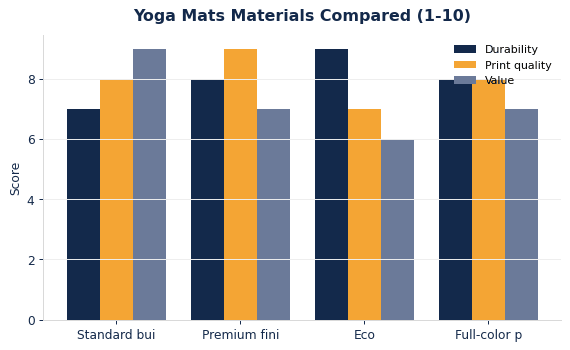
The common materials for custom yoga mats each trade off durability, print quality, and cost: standard build, premium finish, eco / recycled, and full-color print surface. The right pick depends on how the yoga mats will be used, the look you want, and your budget. The chart and table below compare the main options so you can match material to job.
How common yoga mats materials compare on durability, print quality, and value.
As a rule of thumb, choose a recyclable or natural material when eco positioning matters, a coated or laminated option when you want vivid full-color print, and a premium build when the yoga mats is part of a gift or high-end presentation. When in doubt, request a sample so you can judge feel and print before committing to a full run.
Material / option
Best for
Standard build
reliable, cost-effective for high-volume swag
Premium finish
soft-touch or upgraded feel for gifting
Eco / recycled
sustainable option that signals brand values
Full-color print surface
vivid, edge-to-edge branding area
Sizing and specs
Sizing is where many yoga mats orders go wrong, so measure before you order. Custom yoga mats typically range from a compact giveaway up to a larger statement piece, and the right size and format depends on the product or use they serve. Too small and the fit is tight or the product is exposed; too large and you pay for material you do not need and lose a clean, intentional look.
When a measurement falls between standard options, size to the product with a small margin rather than guessing. Confirming the size and format on a proof or sample before a large run prevents the costly mistake of a full order that does not fit, which is far more expensive to fix than a five-minute check up front.
Branding and decoration
Decoration is what turns a plain yoga mats into a branded one. Pad printing and full-color wraps place logos vividly, with engraving or embossing for an upscale, permanent mark. Match the method to your artwork and budget: simple logos reproduce cleanly and cheaply, while detailed, full-color designs shine with the right process on the right material. Keep the artwork vector where possible and confirm the print area for your chosen size.
Restraint usually reads as premium. A clean logo, one or two brand colors, and quality material almost always look more considered than a busy, over-printed design. Approving a proof before the run protects both the look and the budget, especially on a large order of custom yoga mats.
Ordering and budget
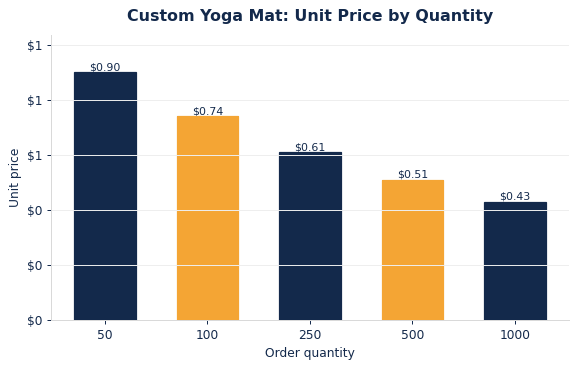
Per-unit cost on custom yoga mats falls steadily with volume as setup amortizes across more pieces, so ordering for real demand rather than a token first batch is usually the efficient move. The curve below shows how pricing typically improves with quantity, which helps you plan an order that balances cash and cost.
Typical per-unit yoga mats pricing as order quantity increases.
Ordering for a recurring need? A single larger run lowers the unit cost and keeps your branding consistent, while a small overage covers reorders and the occasional damaged piece without a rush order.
Common mistakes to avoid
A few avoidable missteps account for most disappointing yoga mats orders. Ordering before measuring is the biggest, followed by choosing a material for price alone without considering how the yoga mats will actually be used, and skipping the proof on a large run. Each is easy to prevent with a few minutes of planning, and each is expensive to fix once a full order is produced.
The other common trap is over-designing the artwork. Cramming in too many colors, effects, or details can muddy the print and raise the cost, especially on textured or recycled materials. Simplifying the design to a clean, legible mark almost always improves both the look and the price of your custom yoga mats.
Frequently asked questions about custom yoga mats
What material is best for custom yoga mats?
It depends on the use: choose a recyclable or natural material for eco positioning, a coated or laminated option for vivid full-color print, and a premium build for gifting or high-end presentation. Request a sample to judge feel and print before a full run of custom yoga mats.
How do I choose the right size?
Measure the product or use the yoga mats serves, then size to it with a small margin so the fit is clean without wasting material. When a measurement falls between standard options, size up slightly and confirm the size and format on a proof before ordering in volume.
How are custom yoga mats branded?
Pad printing and full-color wraps place logos vividly, with engraving or embossing for an upscale, permanent mark. Match the method to your artwork and budget, keep the art vector where possible, confirm the print area for your size, and approve a proof so the finished custom yoga mats match your intent.
How does pricing work, and is there a minimum?
Per-unit cost drops with quantity as setup amortizes across the run, so larger orders are more cost-effective. Order for real demand plus a small overage rather than a token batch, and consolidate recurring needs into one run for the best price.
Can I get a sample or proof before ordering?
Yes, and it is strongly recommended. A physical sample lets you judge material and print, and a digital or physical proof confirms your artwork, color, and size and format before a full run — a small step that prevents a costly mistake on a large order.
What do you need to quote custom yoga mats?
To quote accurately we need the size and format or the product they serve, the quantity, your material preference, and your artwork or a description of the branding. With those details we can recommend the right material and size and give you pricing for the run, and a proof follows once the order is confirmed.
Whatever you order, send vector artwork, confirm material and size and format, and approve a proof before production. For help matching custom yoga mats to a specific use, see our companion guide, our How to Choose Custom Yoga Mats for Your Brand, and explore our our shop to start your order.
Ready to order custom yoga mats?
Tell us your product, quantity, and branding and we’ll match the material, size, and decoration for you.